


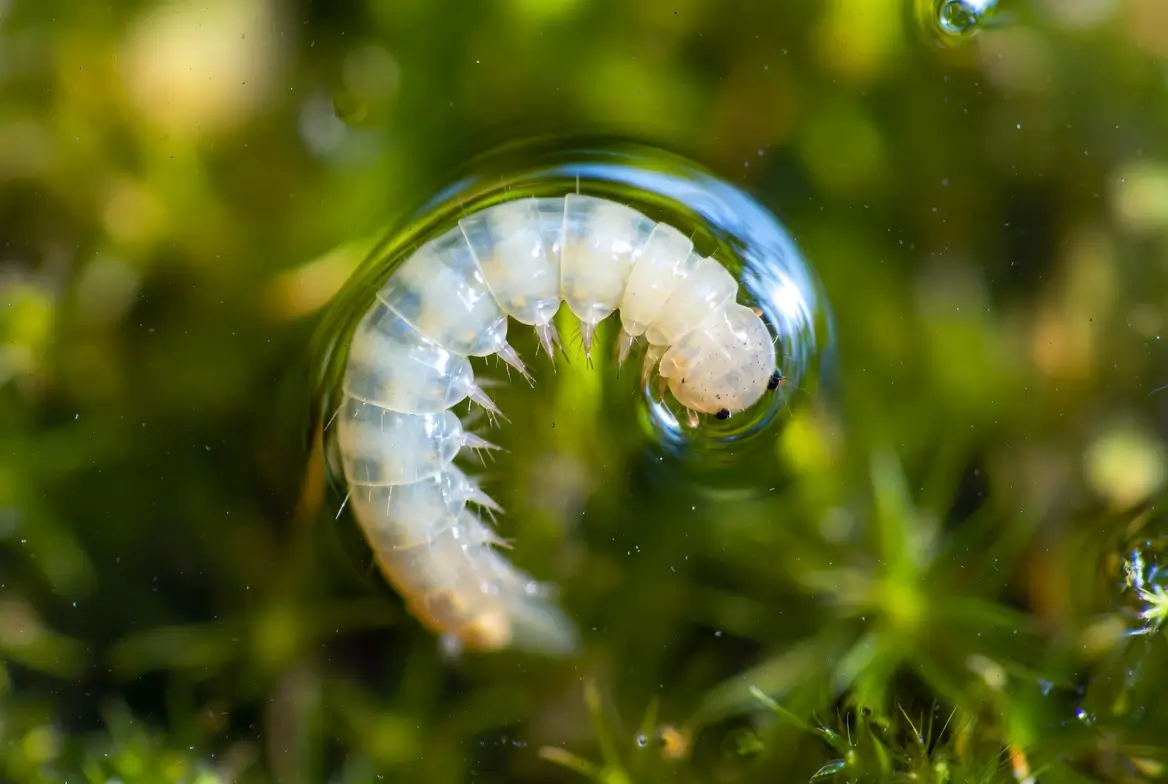
La Mosquito larva is the most vulnerable and the most strategic stage in the development cycle of these insects. Before becoming an adult mosquito capable of biting and transmitting diseases such as dengue or chikungunya, each individual must go through a larval aquatic phase that lasts between 5 and 14 days depending on the temperature. Chez Garden Reclaimer, a specialist in eco-friendly mosquito repellent terminals, we are seeing it on the ground: acting at the larval stage is by far the most effective strategy to stop an invasion before it gets out of control. Understanding where larvae live, how to recognize them, and how to eliminate them is the basis for any Mosquito control serious.
What is the life cycle of the mosquito and what place does the larva occupy?
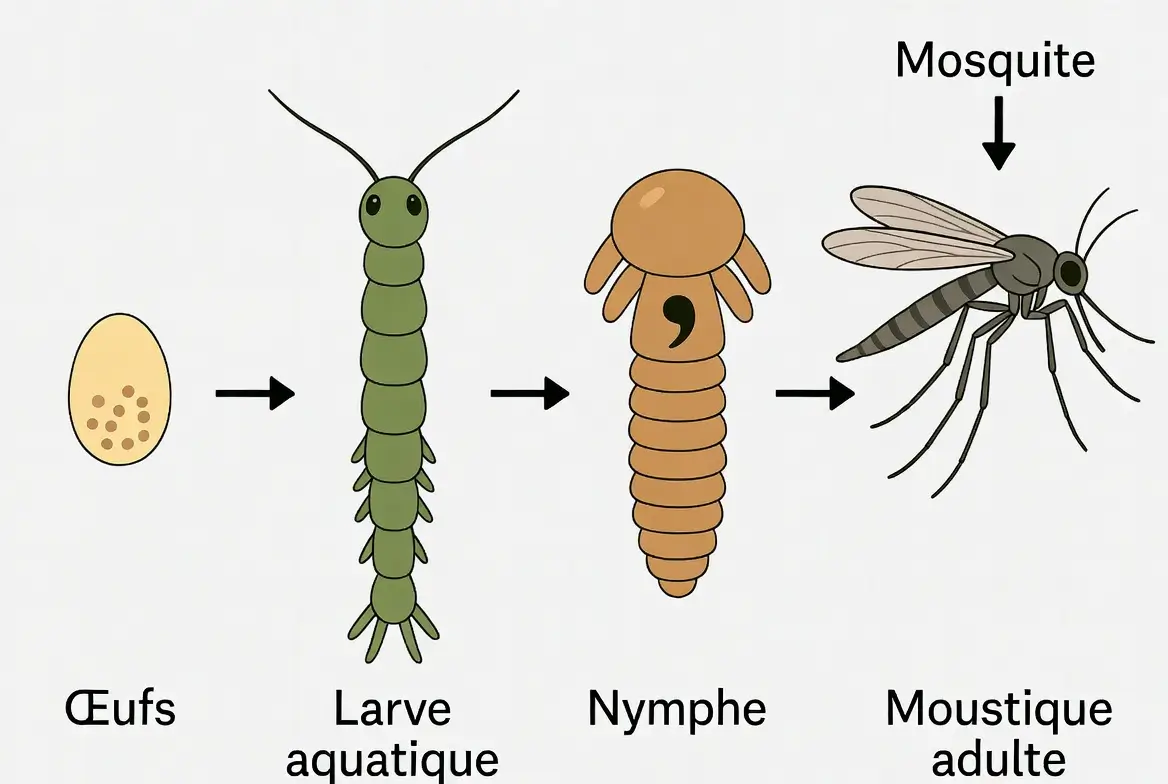
The lifecycle The mosquito consists of four successive stages: the egg, the larva, the nymph and the adult mosquito. Each of these steps takes place in a different environment, but the first three all take place in water. La Mosquito larva is the longest and most metabolically active intermediate stage.
Here are the four stages in chronological order:
- Oeuf : deposited on the surface of the water or on a wall wet, it Hatching in 24 to 72 hours depending on the ambient heat.
- Larva : active aquatic stage, the Mosquito larva Feeds on matter Organics and microalgae. It goes through four mouths (stages L1 to L4) before being transformed.
- Nymph : non-nutritive transition stage, the nymph Don't se nurtures not but remains mobile in the water. It lasts 1 to 4 days.
- Adult mosquito : the emerging insect flies away within minutes of leaving the water to To fertilize or go get food.
In 2025, with increasingly hot summers in France, this cycle can be completed in less than 7 days under optimal conditions, which explains the speed of the proliferations observed each Warm period.
How do you recognize a mosquito larva in water?
Recognizing a mosquito larva In a containing of water is not immediate, because their size is very small and their body often translucent. A mosquito larva measures between 1 and 10 mm depending on its stage of development, has a segmented body elongated, a very distinct head and a Respiratory siphon at the abdominal end which allows him to breathe on the surface.
In concrete terms, here are the signs that make it possible to identify them:
- Characteristic movement : the larva swims jerkily in an S shape and regularly rises to the surface to breathe.
- Vertical position : it stands almost vertically under the surface of the water, head down.
- Visual aspect : body translucent or slightly brownish, dark, rounded head, tail with a visible respiratory tube.
- Surface presence : the larvae Floating and often cluster near the edges or in nooks shaded by containing.
In contrast, the nymph is more compact, comma-shaped, and moves in sudden jerks. She is not nurtures No more but stay visible on the surface. Note that some larvae Like those of Culex pipiens are found exclusively in waters enriched with materials Organics (black water, pools), while the larvae of the Tiger mosquito (Aedes albopictus) thrive in small quantities of clear water.
Where does the female mosquito lay its eggs? The larval sites to watch
La female Mosquito Pond not her eggs at random: she selects specific sites by emitting and detecting chemical signals linked to the presence of water and materials Organics. These sites, called larval lodges, are the starting points for any infestation. Female mosquitos Of the species Culex pipiens prefer stagnant water that is rich in nutrients, while the Tiger mosquito (Aedes albopictus) is gravitational with very small volumes of water even a few milliliters are sufficient.
Les larval lodges the most common in a garden or terrace:
- Gutter obstructed by leaves, where therainwater accumulates without draining.
- Tarpaulin of swimming pool, car or garden furniture, whose folds retain puddles.
- Seau, watering can, flower pot with saucer, or any other containing left to theoutside.
- Mare, ornamental pond or fountain without water circulation or predatory natural.
- Wetlands around outdoor faucets, gutters overflows or terrace joints.
- Rain water collected in uncovered barrels, especially attractants for egg-laying.
A little-known fact but documented by the ECDC: the Tiger mosquito may lay in less than 5 ml of standing water. That's why every nook Humidity of a garden constitutes a Ideal bridge potential and often unseen at first glance.
Main breeding sites and risk level
How do mosquito larvae develop in water? Biology and duration of the larval stage
Beyond identification, understand how Mosquito larva Se develops makes it possible to target interventions at the right time. The larva passes All his life in the water : there she is born, feeds, molts four times and is transformed into a nymph. This stadium larval lasts between 5 and 14 days depending on water temperature and nutrient availability.
La Mosquito larva Lives in waters shallow, rich in organic matter (decomposing leaves, alga, silt) which are its main food source. It filters water with mouth brushes and can nurturing several hundred times per hour. On the other hand, it is totally dependent on the surface to breathe via its Respiratory siphon : without access to air, she quickly perishes.
Factors that speed up or slow development:
- Water temperature : above 25°C, the larval cycle can be reduced to 5 days. Below 15°C, it can belengthen beyond 3 weeks.
- Rich in organic matter : black water or water loaded with alga promote growth Longer and more robust larvae.
- Light and oxygen : the larvae flee direct light and prefer shaded areas with little oxygen.
- Presence of chlorine : highly chlorinated water (well-maintained pool) inhibits larval development, but the chlorine alone is not enough if the rate falls.
How do you get rid of mosquito larvae effectively and without chemicals?
Eliminate mosquito larvae is the most profitable action in an anti-mosquito strategy: one larva eliminated means one less adult mosquito and potentially hundreds of bites avoided. Several methods allow To eliminate the larvae directly In their environment aquatic, safe for humans, pets, or local wildlife.
Here are the most effective methods, ranked in order of ease:
- Physical removal of the cottage : empty, turn over or cover everything containing of stagnant water. This is the most radical and simple method for Stop the cycle at the source.
- BTI (Bacillus thuringiensis israelensis) : this biological larvicide is a natural soil bacterium, inoffensive for humans, animals and The other species aquatic. It destroys larvae in 24 to 48 hours after ingestion. Available in the form of granules or pellets, it is used in barrels, basins and gutters.
- Gambusies : these little fish are predators natural mosquito larvae. Introduced in a Mare or an ornamental pond, they consume The larvae directly and can reduce larval populations by 80 to 90% according to studies by EID Mediterranean.
- Agitation or circulation of water : larvae cannot develop in moving water. A pond pump or a water jet is enough to make the environment hostile.
- Vegetable oil : a few drops of oil Vegetal on the surface of a small collection of water create an impermeable film that asphyxiates the larvae by blocking their respiratory siphon. Method without risk for occasional use.
Note that Not all are equal not depending on the context: BTI is the reference for large volumes, physical suppression remains irreplaceable for small containers.
Chemical-free mosquito larvae: the most effective biological and natural solutions
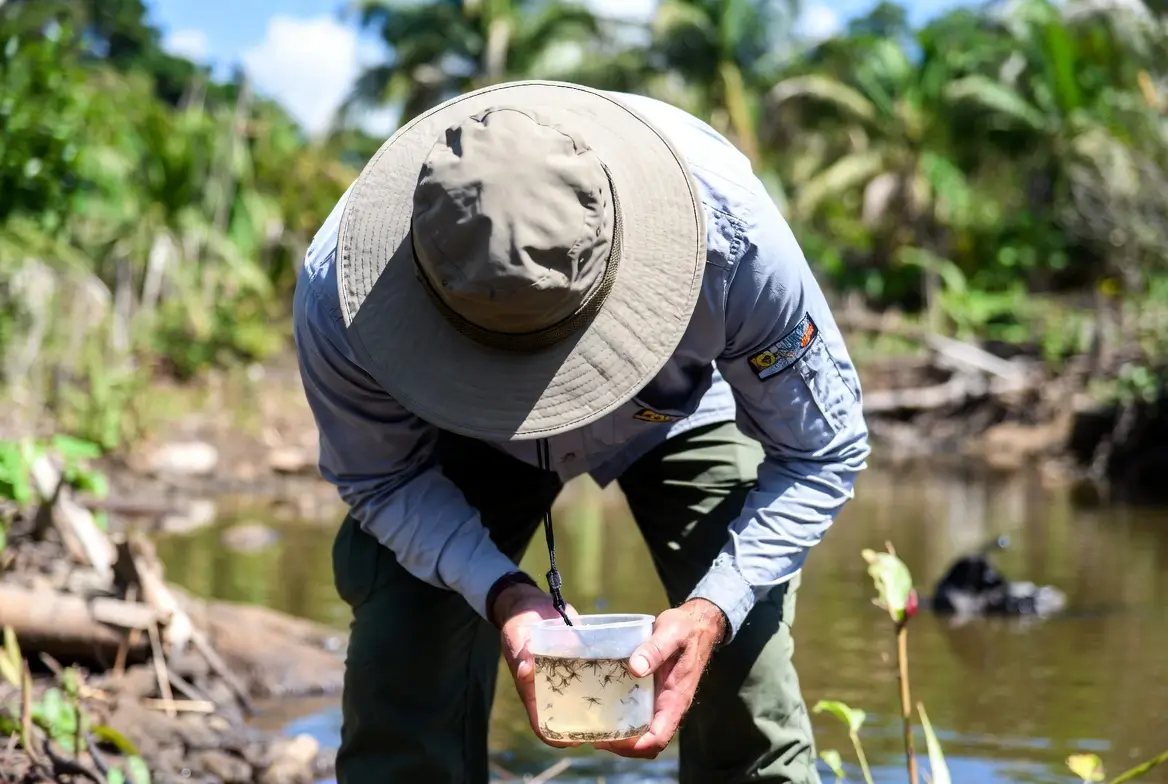
In addition to mechanical methods, eliminate mosquito larvae without Recourse to chemical insecticides is entirely possible and often preferable, especially in vegetable gardens, near wetlands ecologically sensitive or to protect basins ornamentals. Biological solutions have the advantage of being without harming to local biodiversity.
The Bacillus thuringiensis israelensis (BTI) is today the scientific reference in the field of Mosquito control biological. Approved by ANSES in France and used by EID (interdepartmental mosquito control agreements), this biological larvicide acts specifically on mosquito and blackfly larvae, without impacting other insects Aquatics. A BTI pellet placed in a barrel ofrainwater of 200 liters remains active for 4 to 6 weeks.
Other biological and natural solutions:
- Gambusies (Gambusia affinis): larvivorous fish recommended by health authorities for The basins and private pools. Their efficiency has been documented since the 1920s.
- Dragonfly larvae : predators natural, they massively consume mosquito larvae in wetlands untreated.
- Repellent plants : lemongrass, lavender or basil n'Eliminate not the larvae but reduce the attractiveness of the space for the laying of females.
- Mosquito traps Garden Reclaimer: our terminals Mosquito repellent act on also adult mosquitoes in addition to larval management, forming a complete system safe for the environment. They can cover a protective radius of up to 40 meters.
Comparison of methods for eliminating mosquito larvae
What practical tips are there to eliminate mosquito eggs and prevent egg laying in your garden?
Eliminate mosquito eggs Before theyhatch is even more effective than acting in the larval stage. La female mosquito Pond between 50 and 300 eggs per cycle, directly on the surface of the water or on the wall Of a containing wet. Les tiger mosquito eggs are particularly resistant: they can survive desiccation for several months and Hatching as soon as the humidity returns. On the other hand, the Mosquito eggs of Culex pipiens form floating rafts that are visible on the surface of the water -- making them easier to detect and remove.
Here are the most effective tips for get rid of it Before theyhatch :
- Inspect and empty every 4 days : the eggs of the tiger mosquito hatch in 24 to 72 hours. Empty any container outside before this delay interrupts the cycle even before the larval stage.
- Brush the inner walls barrels, buckets and sheeting : the tiger mosquito eggs adhere to Walls and don't go away by simply rinsing -- you have to scratch.
- Cover tightly The barrels ofrainwater with a fine mesh fabric (less than 1 mm) that prevents female of lay.
- Deposit BTI preventively In the basins and Ponds : one trick simple and safe which eliminates the larvae as soon as the eggs hatch.
- Treating gutters at the BTI at the start of each season: it is one of larval lodges the most often overlooked and yet the most pests.
Note that the Mosquito eggs are not destroyed by the majority of repellents cutaneous or Mosquito repellent contact: these products act on the adult mosquito, not on the early stages. The management of the cottages therefore remains thetrick the most structuring.
How to eliminate a mosquito invasion by combining larval management and adult protection?
How to eliminate Long-lasting mosquitos in an outdoor space requires a combination of action on larvae and adult mosquitoes. Acting only on one of the two stages leaves part of the problem untreated. It is this integrated approach that we at Garden Reclaimer apply in the design of our systems of Mosquito control.
A complete and progressive strategy to stop a invasion :
- Week 1 - Audit of cottages : identify and remove all containers ofstagnant water within a radius of 50 meters around the area to be protected.
- Week 1 -- BTI treatment : treat larval lodges impossible to remove (pond, gutter, basin) with a biological larvicide.
- Week 2 -- Perimeter protection : install traps and terminals Mosquito repellent to catch adult mosquitoes that arrive from nearby areas.
- Ongoing -- Monitoring : check the containers after each rain, because therainwater Recreate larval lodges in a few hours.
- In season - Repellents body: complete personal protection with repellents approved during peak twilight activity.
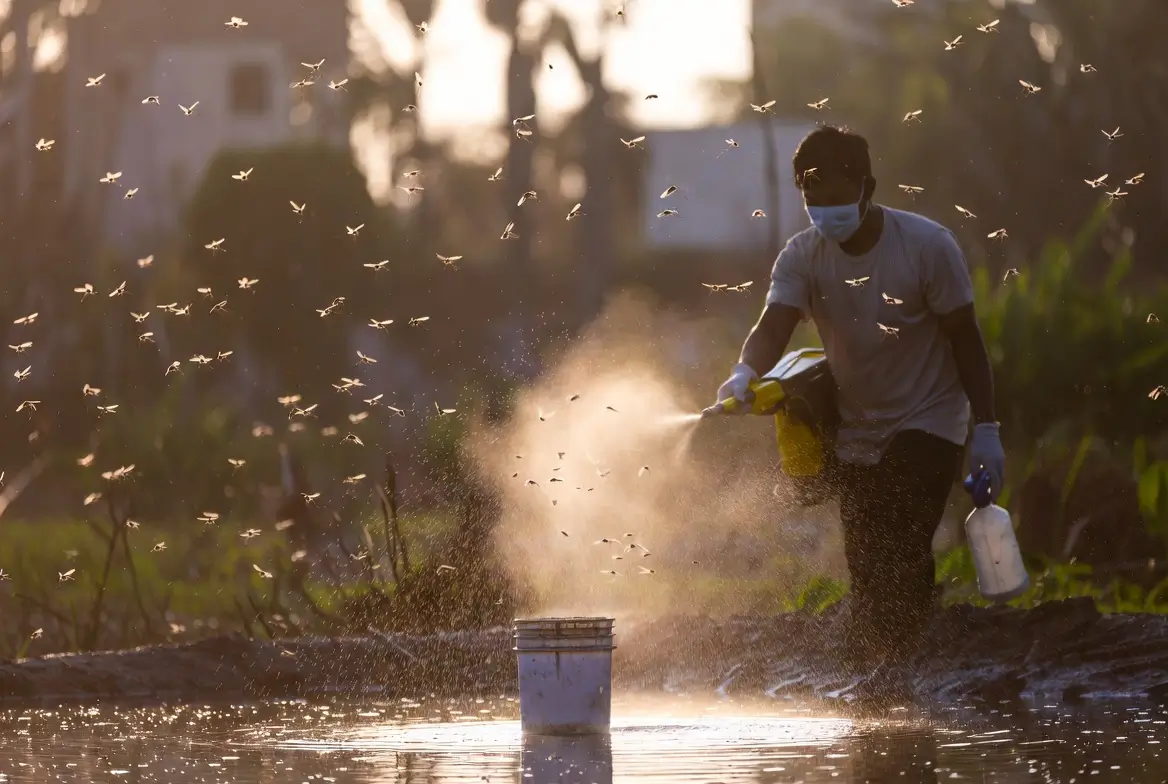
In 2025, the tiger mosquitos are active from May to November in the south of France, and until October in the center. This window of pest S'Lengthens every year, making the establishment of a structured system more and more essential. Our Garden Reclaimer terminals emit specific stimuli to attract and capture also adult mosquitoes within the treated area, in addition to larval elimination.
FAQ - Frequently asked questions about mosquito larvae
How do you get rid of mosquito larvae in a rainwater barrel?
For eliminate mosquito larvae In a barrel ofrainwater, the most effective method and safe is the use of BTI (Bacillus thuringiensis israelensis), a biological larvicide available in garden centers in the form of granules or pellets. A pellet covers a volume of 200 liters for 4 to 6 weeks, acting as soon as the larvae ingest the bacteria. It destroys larvae in 24 to 48 hours without impacting other organisms. Aquatics, domestic animals or humans. In addition, covering the barrel with a fabric with a mesh size of less than 1 mm prevents female of lay New eggs and avoids having to reprocess constantly. Brushing the inner walls of the barrel during each complete emptying also eliminates tiger mosquito eggs that stick to surfaces.
How long does the larval stage of a mosquito last?
The stadium larval A mosquito lasts between 5 and 14 days depending on water temperature and nutrient availability. At 25°C with water rich in organic matter, some larvae transform into nymph in less than a week. Below 15°C, this delay may belengthen up to three weeks or more La Mosquito larva goes through four growth stages (L1 to L4), each marked by a molt, before reaching the pupal stage. It is during this phase that interventions with BTI or predators Like the Gambusies are the most effective, because the larva must nurturing actively and is exposed to biological agents. Past the stadium of nymph, it is no longer possible to act on development before the emergence of adult mosquito.
Is the mosquito larva dangerous for humans?
No, the Mosquito larva is not directly dangerous for humans: it does not stinging no, does not inject saliva and cannot transmit disease at this stage. Its danger is indirect and potential: every larva that comes to term develops one adult mosquito capable of biting and, if the species is a vector, of transmitting viruses such as dengue Or the Chikungunya. La pest is therefore deferred but real. On the other hand, larvae do not cause itch, are not allergenic by contact and do not represent any risk during an accidental swim. Precisely for this reason, their presence in a containing of water often goes unnoticed, allowing the cycle to be completed without intervention precocious. Acting upon detection remains the best strategy.
Can mosquito larvae be eliminated with chlorine?
The chlorine can inhibit the Development of mosquito larvae in a well-maintained pool, but its effectiveness is limited and conditional. A residual level of free chlorine greater than 1 mg/l is necessary to create an environment hostile to larvae. Below this threshold, for example after a heavy rain or at the end of the season, larvae can expand normally. In addition, the use of chlorine in barrels, Ponds or basins Ornamental is not recommended because it destroys wildlife aquatic beneficial and may jeopardise With plants Vegetal surrounding areas. In any case, the BTI remains a solution safe more targeted and more efficiently dosable. For pools, maintaining a stable chlorine level and covering the pool in the off-season are the two most structuring measures against larval proliferation.
How do I know if my garden is infested with mosquito larvae?
Detect a infestation larval in a garden goes through a methodical inspection of all containers likely to retainstagnant water. You must examine the surface of the water against the light or with a lamp: the larvae are often translucent and Invisible with the naked eye without careful observation. A characteristic sign is the jerky S-shaped movement of small filaments under the surface, with regular ascents into the air. Les Mosquito eggs of Culex pipiens form greyish rafts that Floating in a compact group on the surface, visible to the naked eye as soon as you light up the water. The presence of numerous adult mosquitos at dusk in an outdoor space is also an indirect signal that larval lodges assets exist nearby. At Garden Reclaimer, we recommend a systematic inspection after each rain episode, as therainwater can create new lodgings in a few hours.
Do mosquito larvae only live in standing water?
Yes, mosquito larvae They live in waters not very agitated or stagnant, as they cannot withstand the current and need access to the surface to breathe. Les tiger mosquito eggs are placed on Walls humid or on the surface of very small volumes ofstagnant water, sometimes also sparsely only 5 ml. Culex pipiens, on the other hand, prefers the waters richer in materials Organics Like the puddles urban, the gutters dirty or the Ponds poorly oxygenated. Some larvae Tropical species can expand in leaf hollows or hollow bamboos, but the species present in France hexagonal -- mainly Aedes albopictus and Culex pipiens -- are concentrated in larval lodges artificial ones created unintentionally by humans inoutside domestic. This dependence on stagnant water is their weak point: eliminate these lodges. get rid of it It is tantamount to eliminating the problem at its source.
Protecting your garden now: Garden Reclaimer's integrated approach
Act on the Mosquito larva before she became a adult mosquito harmful is the most effective decision you can make each spring. Remove the lodges, treat with BTI, install fish predators and complete the protection with perimeter mosquito bollards: it is this combination that we have integrated into our approach at Garden Reclaimer.
Our eco-responsible terminals complement larval management by targeting adult mosquitoes that enter your living space from nearby untreated areas. Discover all of our solutions on garden-reclaimer.com and prepare your garden before the start of the active season.