


You've just identified an Aedes albopictus in your garden and you're wondering what to do about tiger mosquitoes first? The answer lies in six ordered steps: drain all stagnant water, hermetically cover water reservoirs, report the individual on the official ANSES portal, install a long-range CO₂ trap, limit the passive displacement of eggs during your travels, and unite the neighborhood around a collective approach. Every step counts, because this invasive mosquito has established itself in 78 French departments by 2026, and its individual eradication has become impossible. At Garden Reclaimer, designer of the autonomous terminal GRéco, we have been assisting individuals facing massive invasions for several seasons. This guide condenses the actions that truly work, clearly distinguishing between what is marketing and what produces a measurable result on the local population.
First and foremost, keep one central fact in mind: according to Santé publique France, over 80% ofAedes albopictus larval breeding sites are found in private gardens, on household items that residents tolerate out of habit. In other words, the bulk of the fight takes place at your home, not in public spaces. And if you act alone while your neighbors do nothing, your garden will constantly receive mosquitoes from their stagnant water. This is why the collective dimension is as important as the individual one.

Step 1: Drain all stagnant water in less than 5 days
The first thing to do as soon as you identify a tiger mosquito is to cut off its reproductive cycle at the source. A female lays between 100 and 300 eggs on the damp walls of a container, and these eggs can survive for up to 12 months, waiting for the next rain. But good news: if you eliminate every water point every 72 to 96 hours, the larvae won't have time to reach adulthood. It's free, and it's the most cost-effective action in terms of energy/results.
Take a methodical tour of your outdoor space, notebook in hand, and note every container capable of holding even a small amount of water. The tiger mosquito only needs a teaspoon of liquid to lay eggs. So be paranoid.
- Flower pot saucers : empty them after each watering and every rain, or fill them with sand.
- Gutters and downspouts : clear out leaves twice a year to prevent hidden puddles.
- Rainwater collectors : cover the opening with a fine mosquito net (mesh smaller than 1 mm).
- Children's toys, wheelbarrows, buckets : systematically turn them over as soon as you're done using them.
- Tarps and furniture covers : stretch them properly to prevent them from forming pockets.
- Hollow umbrella bases, stored tires, half-open trash cans : all formidable breeding sites.
- Drip trays under air conditioners and outdoor water heaters : check weekly, as condensation water accumulates there.
For a detailed protocol on eliminating eggs and larvae, consult our guide on how to eliminate mosquito larvae. You will find precise dosages for Bti, the selective biological larvicide that only affects dipterans and preserves fish, dragonflies, and amphibians.
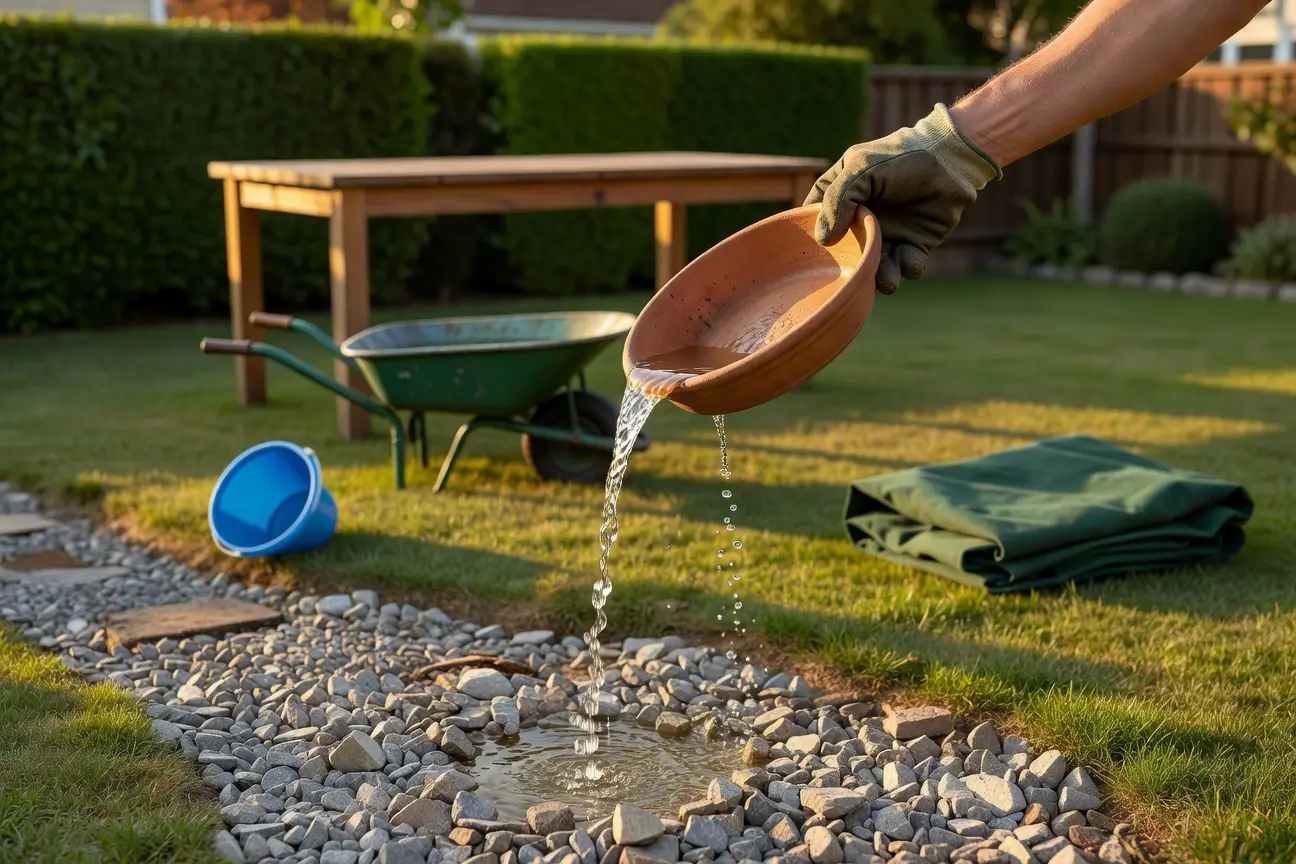
Step 2: Hermetically cover reservoirs that cannot be emptied
Some water points cannot be removed: 500-liter rainwater collectors, buried cisterns, above-ground pools on pause, ornamental ponds with carp. For these volumes, the solution is to physically prevent the female from accessing the surface. A fine-mesh mosquito net (250 µm maximum) stretched and secured with an elastic tensioner does the job for a few euros. Check for any holes or folds that could allow a 5 mm insect to pass through.
For ponds populated with goldfish or koi carp, you don't need to cover them: these fish naturally consume larvae and constitute an effective living trap. However, if your pond lacks aquatic predators, two options are available: introduce mosquitofish (Gambusia, authorized in mainland France under certain conditions) or treat with Bti every 14 to 21 days depending on the temperature. Bti comes in tablet form for €15-30 per season, which remains the most economical preventive investment on the market.
Step 3: Report the tiger mosquito to ANSES (mandatory civic action)
This is a step that many individuals overlook, yet it directly influences public mosquito control policies. Since 2014, ANSES has coordinated the portal signalement-moustique.anses.fr, a citizen science platform that collects observations from individuals to map the real-time progression ofAedes albopictus across the territory. In 2025, over 25,000 reports were recorded, and each valid declaration feeds into the official map used by Regional Health Agencies to trigger targeted operations.
Reporting takes 4 minutes. You enter your municipality, the observation date, attach a clear photo of the insect (dorsal view, wings folded), and validate. An entomologist then verifies if the identification is correct. This step is particularly important if you live in a municipality that does not yet appear as colonized on the official map, because it can trigger a rapid intervention before permanent establishment.
To formally recognize Aedes albopictus and not confuse it with a common mosquito, consult our tiger mosquito identification guide. Key criteria: small size (5 mm), black and white stripes on legs and abdomen, a single white line on the thorax, diurnal behavior (it bites mainly during the day, unlike the Culex).
Step 4: Install a long-range CO₂ trap to break the population cycle
Once prevention is underway, the next step is to deal with already emerging females circulating in the garden and those arriving from outside. This is where active CO₂ attraction trapping becomes fully effective. The principle: a device reproduces the human respiratory signal (carbon dioxide, heat, humidity, cuticular pheromones) within a 30 to 60-meter radius, attracts females seeking a blood meal, and captures them in a net via gentle suction.
Not all traps are created equal. The market offers UV devices for €30, which are perfectly useless against the tiger mosquito (which is not attracted to light), and professional terminals costing several hundred euros that run on propane cylinders. The borne GRéco stands out with its atmospheric concentration reactor that captures ambient CO₂ and concentrates it, without any gas cylinder. The result: fully autonomous operation, an operating cost of €50 to €100 per season, and a measured effectiveness of 85-95% reduction in the local population after 6 to 8 weeks.
The placement of the terminal follows a precise logic. Position it between dense vegetation (hedges, flowerbeds, shaded undergrowth) which serves as a diurnal resting area for females, and your living area (terrace, pool, play area). Elevate the device 60-80 cm from the ground on a stable support, sheltered from prevailing winds. If your plot includes a water point, place the terminal halfway between this area and your terrace to intercept females emerging from the larval breeding site before they reach you.

Why CO₂ trapping surpasses insecticides
Many individuals succumb to the temptation of chemical garden sprays, out of discouragement or due to marketing. However, these deltamethrin treatments indiscriminately kill bees, butterflies, ladybugs, and lacewings, and their effectiveness against mosquitoes decreases season after season due to acquired resistance. The Garden Reclaimer solutions for individuals are based on an inverse logic: capturing only blood-feeding females, without any chemicals, and preserving garden biodiversity. Field surveys show that over 98% of insects captured by the GRéco are mosquitoes or biting midges (Ceratopogonidae), thus having zero impact on pollinators.
Step 5: Limit passive egg displacement during your travels
Here's a little-known but decisive angle. The tiger mosquito is an excellent stowaway: its eggs, glued to the dry walls of a container, can resist for up to 12 months and resume their cycle as soon as they come into contact with water again. Areas still preserved in mainland France (inner Brittany, Auvergne mountains, certain Norman valleys) have been over 70% contaminated by eggs unintentionally transported in used tires, potted plants, damp beach toys, and even flower saucers brought back from second homes.
A few simple precautions prevent you from becoming a vector of contamination. Before each trip to an area not yet colonized:
- Inspect the trunk, wheel wells, and sunroof to identify damp areas where eggs might have been deposited.
- Wash any transported container with boiling water (minimum 60 °C): bucket, planter, saucer, beach bin.
- Avoid buying potted plants in colonized areas without inspecting their saucer and substrate.
- If you transport used tires or stored tarps, dry them completely and store them indoors for 48 hours.
- Upon arriving at your vacation spot, empty and brush any outdoor container before its first use.
These actions are precisely those recommended by ANSES in its 2026 guidelines for individuals in non-endemic areas. The tiger mosquito travels less than 200 m on its own during its lifetime, so the majority of its geographical spread is caused by involuntary human transport.

Step 6: Unite the neighborhood around a collective approach
This is the most difficult and most decisive step in the medium term. If you treat your garden alone while your five neighbors leave saucers and tarps full of water, you will only achieve a marginal reduction in pressure. The average flight range of a female Aedes albopictus seeking a meal is 150 to 200 meters, meaning that all plots within this radius influence your exposure.
Several levers work in practice. Create a messaging group or a thread on your homeowners' association / residents' association website to share best practices. Propose a collective garden visit on a Saturday morning with coffee and an inspection checklist. Ask your town hall for an educational information letter to be distributed to households. If your municipality has a communal mosquito control team, report neglected or fallow land that constitutes uncontrolled reservoirs. The more coordinated the action is at a neighborhood level, the more visible and lasting the population decrease will be.
Table: Actions by urgency level
To help you prioritize, here is a summary table of actions based on their priority level, cost, and time to effect. Print it, hang it in your garage or shed, and check off actions as you complete them.
Tiger mosquito: what to do in case of a massive invasion?
Sometimes, despite individual actions, the pressure remains unbearable: impossible to enjoy the garden, children covered in bites, outdoor meals impractical. What to do in 2026 when the situation gets out of hand? Three complementary levers exist.
Firstly, strengthen active trapping. A single terminal covers a useful radius of 30 to 60 meters. If your plot exceeds 1,500 m² or includes several distinct living areas (terrace + pool + orchard), consider two devices positioned in triangulation. Request free placement advice from our teams: we analyze the master plan of your plot and indicate optimal locations based on prevailing winds and flight corridors.
Secondly, contact your town hall. Many municipalities in colonized areas have a mosquito control service or an agreement with a public operator. They can intervene on neglected land, communal ditches, and wetlands at property boundaries. This public action usefully complements your individual treatment.
Thirdly, adjust your behavior during peak times. The tiger mosquito bites mainly during the day, with two activity peaks (1 to 2 hours after sunrise, and 1 to 2 hours before sunset). Shift outdoor meals to midday, wear loose-fitting, light-colored clothing, and spray a skin repellent based on 30% DEET or 20% Icaridin on exposed areas.
The calendar of seasonal actions in 2026
Timing is an underestimated factor. An approach started too late loses 30 to 50% of its potential effectiveness, because the population has already had time to establish itself.
March (south) / April (north) : initial inspection, complete drainage, installation of the GRéco terminal, first application of Bti. This is the time to get ahead for the season by intercepting founding females before they lay eggs.
May-June : the population increases. Check breeding sites weekly after rains. Renew Bti every 14 to 21 days depending on the temperature. The terminal accumulates captures, and pressure begins to decrease after 3 to 4 weeks.
July-September : seasonal peak. The cumulative effect of the trap reaches its maximum. Empty the capture net every 2 to 4 weeks. Remain vigilant after summer storms, which create ephemeral breeding sites.
October-November : end of season, winter diapause. Clean and store the terminal in a dry place. Take advantage of winter to sustainably landscape the garden: trim overly dense hedges that serve as diurnal refuges, fill in ground depressions, and check the watertightness of rainwater collectors before the first rains of March.
FAQ: What to do about tiger mosquitoes
What should I do if I see a tiger mosquito in my garden for the first time?
Three immediate actions in this order. Firstly, photograph it (dorsal view with wings folded) and report it on signalement-moustique.anses.fr within 48 hours. Secondly, conduct an exhaustive tour of the garden to identify and drain all stagnant water, even a bottle cap full. Thirdly, install a fine mosquito net on any container that cannot be emptied. If the pressure remains high after 2 to 3 weeks, consider a CO₂ trap like the GRéco terminal to reduce the active population. This sequence covers prevention (eggs/larvae), protection (reservoirs), and treatment (adults).
Is the tiger mosquito a health risk in France?
Yes, its potential health impact warrants public attention. Aedes albopictus can transmit dengue, chikungunya, and Zika virus when it bites an infected person and then bites a second person. In 2024, mainland France recorded several dozen autochthonous dengue cases, mainly in the south. The risk remains statistically low for a given household but increases with the density of local tiger mosquitoes. This is why reporting and preventive measures are civic duties, not just matters of comfort. Children, immunocompromised individuals, and pregnant women are the populations most in need of protection.
Which products should you absolutely avoid for tiger mosquitoes?
Avoid UV traps (tiger mosquitoes are not attracted to light; these devices mainly kill moths), essential oil mosquito repellent bracelets (almost no effectiveness beyond 30 cm), ultrasonic devices (no serious scientific study validates their effectiveness), and self-applied deltamethrin garden sprays (risk to bees, cats, and children, and acquired resistance by local populations). Always prioritize targeted solutions: Bti for larvae, CO₂ traps for adults, and mosquito nets for openings.
How long does it take to see an effect on the tiger mosquito population?
Allow 7 to 14 days for breeding sites to be emptied (the time it takes for existing larvae to complete their cycle or die from desiccation). Bti acts on treated larvae within 24 to 48 hours. CO₂ traps show their first visible effects after 3 to 4 weeks, reaching a cruising speed of 85-95% reduction after 6 to 8 weeks. Collective neighborhood mobilization yields results over 1 to 2 full seasons. So be patient: fighting the tiger mosquito is a marathon, not a sprint, but it pays off long-term when done methodically.
Should you call a professional mosquito control company?
In 90% of cases, no. Professional sprays costing €150-400 per application kill pollinators in your garden and lose effectiveness season after season due to resistance. They don't treat eggs, so the population rebuilds after the next rain. The individual solutions described in this guide (emptying breeding sites, Bti, CO₂ traps, collective mobilization) are more ecological, more economical, and more sustainable. Professional mosquito control only makes sense in exceptional situations: a one-off high-stakes event (wedding, outdoor reception) or a health alert validated by the ARS during a suspected autochthonous case.
How to protect a baby or young child from tiger mosquitoes?
Combine multiple barriers. At home, install mosquito nets on the crib and bedroom windows (mesh smaller than 1 mm). Outdoors, dress the child in long sleeves and light-colored pants, especially during peak activity (morning and late afternoon). Never use DEET or picaridin-based skin repellent on a child under 6 months; for older children, choose an age-appropriate concentration and apply it to clothing rather than skin. Reduce the source pressure: a garden treated with a GRéco terminal reduces the number of tiger mosquitoes likely to approach the play area or terrace by 85 to 95%, which naturally limits bites without any product applied to the child.