


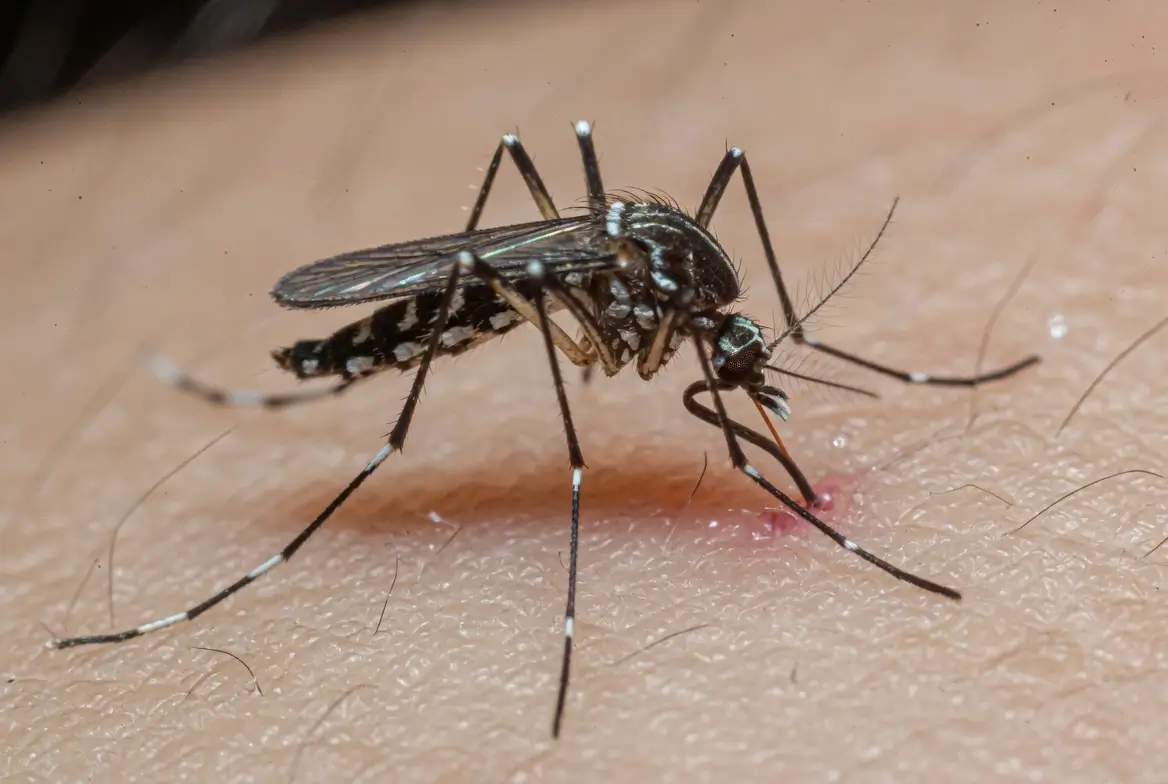
La Lifespan of a mosquito depends primarily on its sex and species. The male lives an average of 7 to 10 days, the female Culex (common mosquito) lasts 30 to 45 days, and the female Aedes (tiger mosquito) can reach up to 60 days in optimal conditions. These considerable differences explain why females, who are the only stingers, have time to lay several hundred eggs and build up a sustainable summer population in your garden.
At Garden Reclaimer, designer of the Mosquito repellent terminal GréCo, we study this biological data closely because it conditions any protection strategy. Understanding how long a mosquito lives makes it possible to target the exact window where the CO₂ terminal must work to break the reproductive cycle over 6 to 8 weeks. This guide details the precise figures by species, the environmental factors that extend or shorten this period, and the direct consequences on garden control in 2026.

The lifespan of a male mosquito: only 7 to 10 days
The male mosquito has a short life expectancy, of 7 to 10 days on average, and it never bites. It feeds exclusively on nectar and vegetable juices to produce the energy needed for flight and reproduction. Its only biological function is to fertilize females in the first few days after its emergence, after which it dies rapidly, often exhausted by breeding swarms.
This brevity of life is an asset for control strategies targeting females. In fact, CO₂ traps like GréCO almost exclusively attract females in search of blood, so act on the Lifespan of a mosquito female is enough to collapse the local population. The males disappear naturally in less than two weeks, without requiring specific intervention.
The lifespan of a female Culex mosquito: 30 to 45 days
The female of the common mosquito (Culex pipiens), the most common species in mainland France, lives on average 30 to 45 days during the active season. During this period, it takes 3 to 5 blood meals, lays about 100 to 300 eggs in each cycle, and can therefore generate several hundred offspring in a single month. It is this reproductive potential that transforms a weak spring presence into a massive nuisance in July-August.
But the lifespan of a Culex mosquito can increase dramatically in winter. Fertilized females enter diapause (a kind of hibernation) in cellars, garden sheds or manholes. They then survive 6 to 8 months, sometimes longer, and restart their egg-laying cycle as soon as the first warm weather in March-April occurs. To understand this reproductive mechanism, check out our comprehensive guide on The life cycle of the mosquito.
The lifespan of a tiger mosquito: up to 60 days
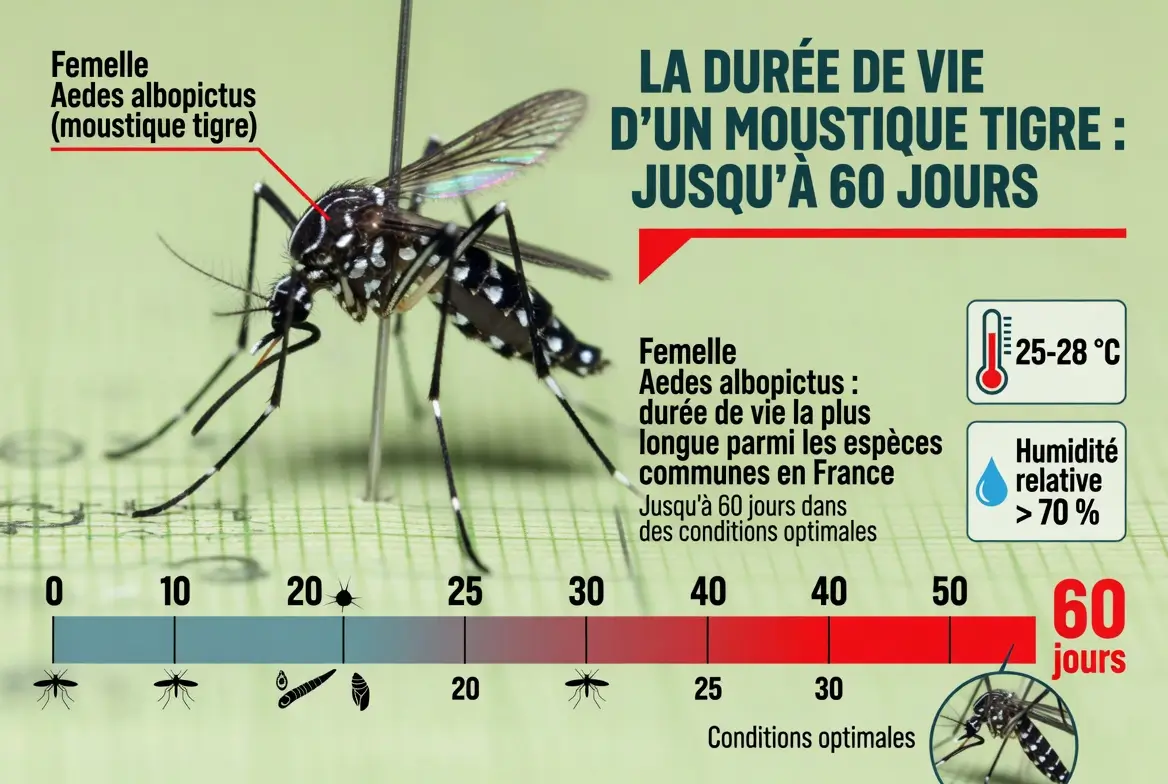
The female Aedes albopictus, aka tiger mosquito, has the longest lifespan among the common species in France: up to 60 days under optimal conditions (temperature of 25-28°C, relative humidity greater than 70%). This peak in life expectancy partly explains its rapid expansion since 2004 in France, where the tiger mosquito is now established in more than 78 departments in 2026 according to ANSES.
This longevity is accompanied by a particular egg-laying strategy: the female Aedes lays her eggs in several batches on the dry wall of containers which will then be filled with water (saucers, blocked gutters, forgotten toys). The eggs resist desiccation for 6 to 8 months and hatch upon first contact with water. So even when the adult female is dead, her offspring remain ready to emerge the following year. To recognize this species and report its presence, read our dedicated article on Mosquito eggs.
Factors that influence the lifespan of a mosquito
La Lifespan of a mosquito is never fixed. It varies significantly according to three main environmental parameters that every garden owner needs to know in order to understand the population dynamics they observe each season.
The temperature. It is the most decisive factor. At 15°C, an adult mosquito lives up to 50-60 days but reproduces slowly. At 25-28°C (the optimum), it lives 30-40 days but accelerates its reproduction considerably. Above 35°C, metabolism spirals out of control and life expectancy drops to only 10-15 days, but population pressure remains strong as the outbreaks keep coming. When nighttime temperatures drop below 10°C, activity stops and females enter a diapause.
Humidity. Mosquitos quickly lose water through their cuticles. Relative humidity greater than 70% extends their life by 30-50% compared to a dry environment (40-50% humidity). This is why gardens with trees, shade and close to a water point are home to denser and more sustainable populations than areas that are dry and exposed to full sun.
Access to resources. A female that easily finds blood (humans, pets, birds) and egg-laying sites (clean standing water) maximizes her longevity and fecundity. Conversely, a female that has to fly for a long time to eat consumes her energy reserves more quickly and dies sooner. La Lifespan of a mosquito is thus directly linked to the richness of its immediate environment.
Natural mortality. In wild conditions, only 5 to 15% of adult mosquitoes reach their theoretical maximum age. Predators (dragonflies, bats, insectivorous birds, spiders), heavy rains, wind gusts, and extreme temperatures eliminate the majority of individuals before they die of old age.
Species and lifespan: the complete comparative table
Why does the lifespan of a female mosquito affect the fight
Know the Lifespan of a mosquito Female is radically changing the way of thinking about garden protection. A 30-45 day old Culex female that lays eggs every 3 to 4 days can generate 4 to 6 egg laying cycles before dying. So 1 female not caught in mid-May produces up to 1800 eggs over its entire life, half of which will give females, which in turn will lay 100 to 300 eggs each.
This exponential calculation explains why 6 to 8 weeks of continuous capture is enough to collapse a garden population. The GréCo terminal captures females before their first or second blood meal, so before their first egg-laying. Each female that is intercepted represents several hundred avoided offspring. This is exactly the time window needed to break the local reproductive cycle, based on the natural lifespan of adults.
To discover the precise operation of the terminal and its atmospheric concentration reactor, consult our page GréCo solution.
Control strategy based on the lifespan of a mosquito
La Lifespan of a mosquito dictates the optimal protection schedule. Here is the three-step strategy validated by feedback from GréCo since 2020.
Phase 1: spring interception (April-May). The first fertilized females emerge from diapause. Their residual lifespan is 4 to 8 weeks. Capturing these female founders prevents the formation of the first summer generation. This is the most profitable window of the entire season, as each female intercepted at this point represents thousands of offspring avoided by September.
Phase 2: continuous pressure (June-August). Generations follow one another every 4 to 6 weeks. The terminal works continuously to intercept each cohort of females before their first blood meal. This pressure maintained over 6 to 8 weeks reduces the population by 85 to 95% according to surveys carried out on equipped gardens. Individuals GréCo users notice this decrease as early as the second season of operation.
Phase 3: winter preparation (September-October). Temperatures are dropping and females are looking for shelter for the diapause. A final catch at this stage reduces the stock of fertilized females that would have survived until the following spring. This is a cumulative effect: over 2 to 3 seasons, the local population falls permanently, as the wintering reservoir is gradually depleted.

Misconceptions about the lifespan of a mosquito
Several beliefs circulate about the longevity of mosquitoes and hinder the effectiveness of control strategies. Here are the corrections needed in 2026.
“A mosquito lives for 24 hours.” Wrong This confusion undoubtedly comes from mayflies, which are another family of insects. The female mosquito lives on average 30 to 60 days depending on the species, or 30 to 60 times longer than this received idea suggests. This error leads to underestimating the reproductive potential of a female and therefore the urgency to act early in the season.
“The mosquito dies after it bites.” Wrong as well. Unlike the bee, which loses its sting, the female mosquito largely survives the sting and repeats it every 3 to 4 days to lay eggs. It is precisely this repetition that makes a female harmful over her entire lifespan.
“If I kill a mosquito, I'm killing an entire family.” Partially true and that is what is at stake. Killing an adult female before it lays eggs for the first time effectively avoids 1,500 to 1,800 offspring in its lifetime. But that means catching it before its first blood meal, so before it stings. CO2 trapping excels precisely on this point since it intercepts females in their host-seeking phase, before the sting.
Lifespan of a mosquito: impact on garden comfort
Once the Lifespan of a mosquito understood, expectations regarding a protection strategy become realistic. A treatment never produces an immediate effect, because the population present on D-day will live another 2 to 6 weeks, even if no new females emerge. It is this natural delay that explains why 6 to 8 weeks are needed to notice a clear reduction in bites.
In a garden equipped with a GréCo terminal, the first captures start as soon as it is put into service, but the effect on the feeling is evident after 3 to 4 weeks, when the population of adult females begins to decrease more quickly than it is renewed. After 6 to 8 weeks, the garden enters a phase of lasting tranquility where mosquito pressure remains low until the end of the season. For a personalized audit of your garden and adapted investment advice, contact the Garden Reclaimer team.
This biological reality is confirmed by research byANSES on mosquito vectors, which accurately documents the lifespans per species and the associated environmental conditions. The GréCo terminal relies on this data to calibrate its intervention schedule.
FAQ: lifespan of a mosquito
How long does a mosquito live on average?
The lifespan of a mosquito varies greatly depending on sex and species. The male lives 7 to 10 days and never stings. The female Culex (common mosquito) lives 30 to 45 days during the active season, and can reach 6 to 8 months in winter diapause. The female Aedes albopictus (tiger mosquito) lives up to 60 days in optimal conditions (25-28°C, humidity greater than 70%). These considerable differences explain why only females, with their long lifespan and high reproductive potential, are the real nuisance in a garden.
Why does the male mosquito live so short of time?
The male mosquito has a unique biological function: to fertilize females. It devotes all its energy to breeding swarms and dies quickly after mating, usually in 7 to 10 days. His diet is limited to nectar and vegetable juices, which do not provide the proteins needed for extended life. It never stings and therefore has no role in the nuisance experienced in the garden. All control strategies target females, who lay eggs and sting.
Is the lifespan of a tiger mosquito really longer?
Yes, the female Aedes albopictus can reach 60 days, compared to 30 to 45 days for the common Culex. This increased longevity, combined with eggs that are resistant to desiccation for 6 to 8 months, explains the rapid expansion of the tiger mosquito since 2004 in France, now established in more than 78 departments in 2026. The female lays several batches of eggs on the dry walls of containers (saucers, gutters, toys) which hatch upon first filling. So even dead, she leaves offspring ready to emerge the following year.
How does temperature affect the lifespan of a mosquito?
Temperature is the most important factor. At 15°C, an adult mosquito lives 50 to 60 days but reproduces slowly. At 25-28°C (the biological optimum), it lives 30 to 40 days and accelerates its reproduction. Above 35°C, life expectancy drops to 10-15 days but hatching continues and the pressure remains strong. When nighttime temperatures drop below 10°C, activity stops and females enter a diapause, where they can survive 6 to 8 months until the following spring.
Do all mosquitos die in winter?
No, it's a persistent misconception. Fertilized females of common species (Culex pipiens in particular) enter into diapause in cellars, garden sheds, rainwater manholes and other temperate zones. They thus survive 6 to 8 months and restart their egg-laying cycle as soon as the first warm weather in March-April occurs. The eggs of Aedes albopictus (tiger mosquito) resist freezing and desiccation for 6 to 8 months on dry walls. Therefore, an effective control strategy anticipates this winter stock by intervening in spring.
Is the lifespan of a female mosquito sufficient to constitute an infestation?
Extensively. A female Culex lives 30 to 45 days and lays 100 to 300 eggs per cycle, with one cycle every 3 to 4 days. Over its entire lifespan, it generates 1,500 to 1,800 offspring. If half are females, and each one lays eggs in turn, a single founder not caught in May may be the source of several tens of thousands of mosquitoes by September. It is precisely this exponential calculation that justifies the installation of a CO₂ trap as early as spring: intercepting the founders before their first eggs are laid is the most profitable lever of the whole season.