


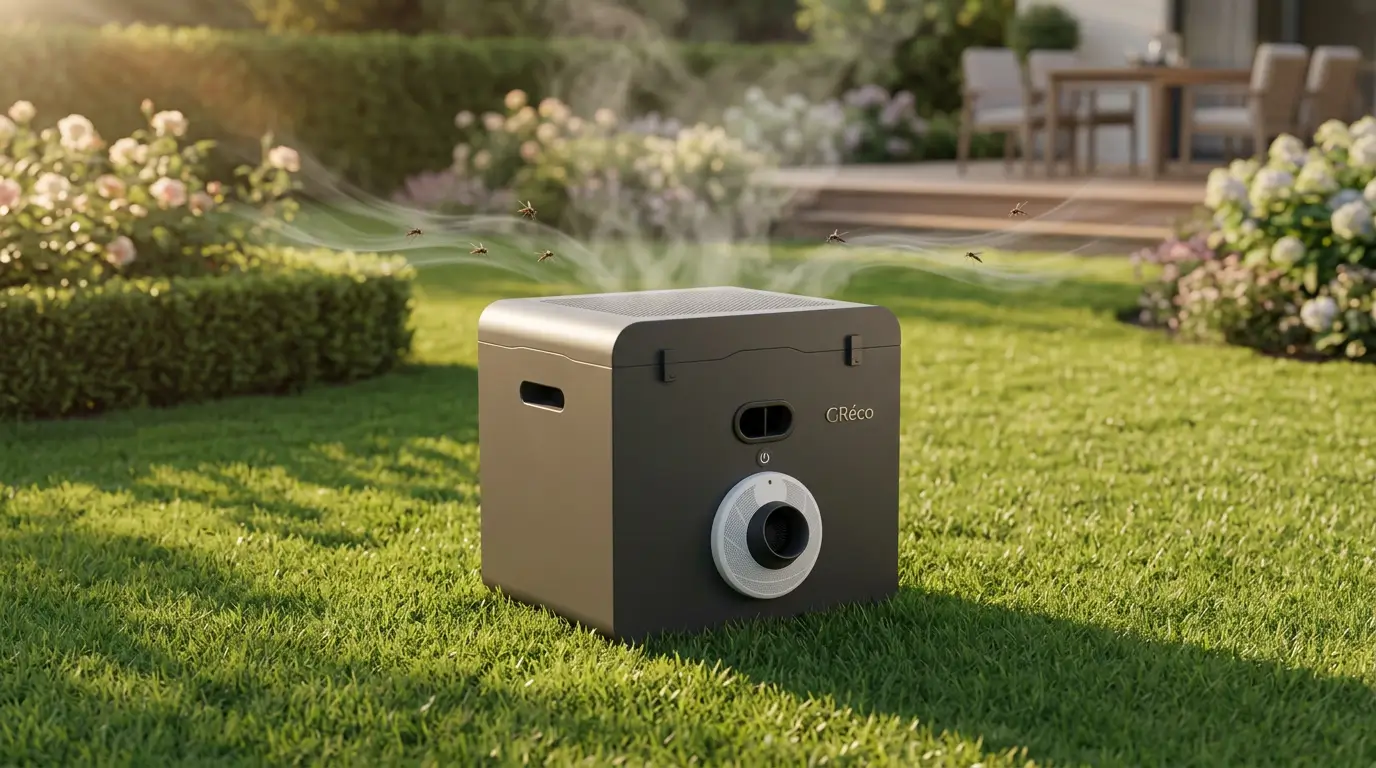
The CO2 mosquito trap is a capture device that exploits the main attraction signal of female mosquitoes: carbon dioxide. At Garden Reclaimer, designer of the Mosquito repellent terminal GréCo, we have been working on this technology for several years with a simple observation: CO₂ is the only stimulus capable of attracting mosquitoes at a long distance, well beyond what UV lamps or chemical repellents allow.
In concrete terms, each human being emits approximately 200 ml CO₂ per minute while breathing. Female mosquitoes, those that bite, detect this gas several tens of meters away thanks to ultra-sensitive olfactory receptors located on their antennae. The CO2 mosquito trap reproduces this signal by diffusing carbon dioxide in a controlled manner, combined with heat, humidity and olfactory attractants that mimic the scent of human skin.
Once attracted nearby, mosquitoes are sucked up by a fan into a retention net where they dehydrate within a few hours. This process is purely mechanical: no insecticide, no pesticides, no harmful chemical substances. By continuously capturing breeding females, the trap causes a Breaking the reproductive cycle on the treated area, with measurable results as early as 6 to 8 weeks.
.webp)
- Long distance attraction : CO₂ attracts mosquitoes within a radius of 30 to 60 meters depending on the model.
- Precise targeting : only females looking for blood are attracted to the CO₂ + pheromone signal.
- Mechanical capture : fan suction, without chemicals or insecticides.
- Cumulative effect : each female captured represents up to 300 fewer eggs in the environment.
That's why the CO₂ trap is considered by entomologists to be the most reliable capture method, validated by studies by EID Mediterranean and CNRS. To learn more about the biological cycle of mosquitoes and understand the impact of this reproductive break, consult our article on the Mosquito life cycle and the elimination of larvae.
How does CO2 technology work in a mosquito trap?
Not all CO2 mosquito traps are created equal. The way carbon dioxide is produced is the fundamental difference between the models available on the market. In 2026, three main categories coexist, each with its own advantages and logistical constraints.
CO₂ bottle traps. It is the most common technology. The trap is connected to a gas tank (propane or pure CO₂) which diffuses carbon dioxide at a controlled rate. The effectiveness is proven, but the logistical constraint is strong: you have to replace the bottle every 3 to 4 weeks in high season, store the bottles and manage deliveries.
Catalysis traps (propane). Some models burn propane to produce CO₂ through catalytic combustion. The process simultaneously generates heat and humidity, which enhances the attractiveness of the signal. On the other hand, gas consumption and the cost of refills remain high.
Traps for the autonomous generation of CO₂. This is the innovation supported by the GréCo terminal by Garden Reclaimer. One integrated smart reactor concentrates and releases the CO₂ already present in the ambient air, without bottles or bottles. This approach completely eliminates the dependence on gaseous consumables and makes the device carbon neutral. GréCO combines this reactor with a complete signal (CO₂, heat, humidity, pheromones) with a range of up to 60 meters.
- CO₂ bottle trap : proven effectiveness, but frequent refills and recurring gas costs.
- Propane catalytic trap : rich signal (CO₂ + heat + humidity), but high fuel consumption.
- Autonomous trap (GréCo type) : zero bottles, zero gas refills, continuous operation throughout the season, carbon neutral.
Note that photocatalytic traps (UV + TiO₂), often sold as “CO₂ traps”, actually produce only a tiny amount of carbon dioxide, which is insufficient to attract mosquitoes from a distance. They should not be confused with real CO2 mosquito traps. To find out in detail how the Garden Reclaimer autonomous reactor works, go to our page GréCo technology.
CO2 mosquito trap: comparison of the main solutions in 2026
The choice of a CO2 mosquito trap depends on several criteria: area to be protected, budget, desired level of autonomy and maintenance constraints. This comparison summarizes the characteristics of the main categories of traps available in France in 2026.
This comparison highlights a clear observation: CO₂ traps clearly outperform other categories. Among them, the GréCo terminal stands out for its total autonomy in gas and its maintenance is almost non-existent. On a 9-week field test, the most efficient CO₂ models show a reduction in the mosquito population of between 70 and 88% on the treated plot.
- For small areas (balcony, terrace) : an olfactory trap may suffice in addition to other preventive measures.
- For gardens of 200 to 2,000 m² : the CO₂ trap is the reference solution, with only one well-positioned unit.
- For large spaces (parks, hotels, campsites) : a network of connected CO₂ terminals offers the best coverage.
How to choose and install the right CO2 mosquito trap?
The effectiveness of a CO2 mosquito trap depends as much on the model chosen as on its positioning in the field. A poorly placed trap can lose up to 50% of its catch potential. Here are the essential rules to follow to maximize results.
Position the trap between mosquito resting areas and your living areas. Mosquitos take refuge in hedges, bushes, and wetlands during the day. The trap should be placed halfway between these natural refuges and your terrace or pool. Thus, it intercepts mosquitoes before they reach your relaxation areas.
Respect a distance of 10 to 15 meters from the terrace. The trap actively attracts mosquitoes to it. If you place it too close to your living area, you may temporarily increase the nuisance instead of reducing it. A distance of 10 to 15 meters is the optimal compromise in most configurations.
Avoid areas exposed to wind. The CO₂ plume must travel through calm air to attract mosquitoes from a long distance. A location exposed to the dominant wind disperses the signal and greatly reduces the radius of attraction. Choose locations sheltered by hedges or walls.
Start the trap 4 to 6 weeks before the peak of the season. The effectiveness is cumulative. The sooner you start (as early as March-April in the south of France, May in the north), the more females you intercept before they lay eggs. At Garden Reclaimer, we see that customers who start early get significant results well before summer.
- Ideal location : between hedges or wetlands and the terrace, sheltered from the wind, on flat ground.
- Distance from living areas : between 10 and 15 meters minimum.
- Feeding : 220 V socket nearby (most CO₂ traps require a permanent connection).
- Start-up : 4 to 6 weeks before the first mosquitoes appear to break the reproductive cycle.
For complex grounds or large areas, Garden Reclaimer offers a free mesh diagnosis in order to determine the number of terminals required and their optimal placement. Request your field study to our team.
.webp)
Against which species of mosquitoes is this trap effective?
The CO₂ trap targets all mosquito species present in mainland France and overseas. However, its effectiveness varies according to the species and the combination of signals emitted by the device.
The tiger mosquito (Aedes albopictus). It is the most feared species in France, present in 71 departments in 2026. The tiger mosquito is particularly sensitive to CO₂ and to olfactory attractants such as lactic acid. Well-calibrated CO₂ devices have high catch rates on this species, which is responsible for the transmission of dengue, chikungunya and Zika.
The common mosquito (Culex pipiens). Active mainly at dusk and at night, the Culex is just as sensitive to the CO₂ signal. It accounts for the majority of nuisances in temperate regions and can transmit the West Nile virus (West Nile).
Tropical species (Aedes aegypti). In offshore departments (Guadeloupe, Martinique, Martinique, Réunion, Guyana), the CO₂ trap is also effective against endemic vector species. These territories, facing recurrent epidemics of dengue, are priority areas for the deployment of professional traps.
An essential point: the CO₂ trap does not attract pollinating insects (bees, butterflies, bumblebees). The CO₂ + pheromones signal specifically targets hematophagous female mosquitoes. This is a decisive advantage over insecticides, which indiscriminately destroy the entire entomological fauna.
- Tiger mosquito : high sensitivity to CO₂, high capture rates from the first weeks.
- Common mosquito : effective capture in the evening and at night, when the species is most active.
- Tropical species : validated effectiveness in an offshore environment against Aedes aegypti.
- Pollinators : no impact, the signal only attracts female mosquitoes in search of blood.
To precisely identify the species present in your home, consult our guide: How to recognize and report the tiger mosquito.
Preparing for the 2026 season: when should you invest in a CO₂ trap?
The fight against mosquitoes is a race against time. Each week of delay, an additional generation of mosquitoes settles on your land. In 2026, experts anticipate a particularly intense season due to the mild winters and humid springs observed in recent years.
Combine the CO₂ trap with preventive actions. Even the most effective trap is more effective if you eliminate the breeding grounds around your home. Empty the flower pot saucers, turn the buckets and wheelbarrows upside down, cover the rainwater collectors and clean the gutters. A single plug of standing water is enough for a tiger mosquito to lay up to 300 eggs.
Follow the results and adjust. With a connected trap like the Garden Reclaimer GréCo terminal, you can monitor the capture rate in real time and adapt the parameters (eco mode in case of low pressure, performance mode during peaks). This data-driven approach maximizes efficiency while optimizing power consumption.
What budget should you plan for? In 2026, prices range from €250 for an entry-level olfactory trap At more than €2,500 for a professional CO₂ device top of the range. Garden Reclaimer also offers a rental model starting from €300/month, installation and maintenance included, particularly suitable for budgets that do not want to make a significant initial investment.
- February-March : order and plan the installation of your CO₂ trap.
- Avril : setting up the trap, eliminating stagnant water, checking the mosquito nets.
- May-September : continuous operation, catch monitoring, adjustment if necessary.
- October-November : storage and storage of the trap in a dry and temperate place.
.webp)
To learn more about the health risks associated with mosquitoes and understand why protection is essential, read our report on diseases transmitted by mosquitoes.
FAQ: CO2 mosquito trap, your questions, our answers
Is a CO2 mosquito trap really effective against the tiger mosquito?
Yes, this type of trap is particularly effective against the tiger mosquito (Aedes albopictus). This species is very sensitive to the CO₂ signal combined with olfactory attractants such as lactic acid. Field studies conducted in heavily infested areas show a reduction in the tiger mosquito population of up to 80% after 6 to 8 weeks of continuous operation. The Garden Reclaimer GréCo terminal targets both tiger mosquitoes and common mosquitoes thanks to its comprehensive human signal combining CO₂, heat, humidity and pheromones.
What is the difference between a bottle CO₂ trap and a standalone CO₂ trap?
The fundamental difference lies in how carbon dioxide is produced. A bottle trap uses a CO₂ or propane tank that must be replaced every 3 to 4 weeks. An autonomous trap like the GréCo by Garden Reclaimer generates its own CO₂ from the ambient air thanks to an integrated intelligent reactor. This technology completely eliminates the dependence on gaseous consumables, reduces operating costs and makes the device carbon neutral.
How much does a CO₂ trap cost in 2026?
Prices vary greatly depending on the technology. Count between €250 for a basic olfactory trap and more than €2,500 for a professional CO₂ trap with connectivity and intelligent control. Garden Reclaimer also offers rental packages starting at €300/month, installation and maintenance included. This rental model eliminates the initial investment and includes technical support throughout the season.
Is the CO₂ trap dangerous for bees and pollinators?
No, the CO₂ trap exclusively targets female mosquitoes in search of blood. The attraction cocktail (CO₂, heat, humidity, pheromones) reproduces signals specific to the search for blood, to which bees, butterflies, dragonflies and other pollinators are not sensitive. Unlike chemical insecticides that indiscriminately eliminate all insects in an area, the CO₂ trap fully preserves the useful biodiversity of your garden.
What surface area can a CO2 mosquito trap cover?
The area covered depends on the model and the strength of the transmitted signal. The CO₂ free olfactory traps cover 10 to 20 meters in radius. Bottle CO₂ traps reach 30 to 60 meters. The Garden Reclaimer GréCo terminal covers up to 60 meters in radius, which is approximately 1 hectare of land. For a garden of 1,000 m², a single well-positioned bollard is generally sufficient. For large areas, a network of several connected terminals guarantees homogeneous coverage.
How long does it take to see the results of a CO₂ trap?
The first results are visible from the first weeks of operation, with a noticeable reduction in bites. Maximum efficiency is achieved after 6 to 8 weeks, the time required to interrupt the local breeding cycle. By continuously capturing breeding females, the trap prevents the birth of new generations. The results are long-lasting and improve throughout the season.