



Mosquitoes bite because the female needs blood proteins and iron to produce her eggs. The male, however, never bites: he feeds exclusively on nectar and plant sap. Understanding why mosquitoes bite allows for the implementation of a targeted protection strategy, as biting is not an act of predation but an act of reproduction. At Garden Reclaimer, designers of the GRéco mosquito trap, we precisely leverage this biology to intercept reproductive females before they bite.
In 2026, olfactometry research has made significant strides: French laboratories such as IRBI in Tours and the University of Montpellier have identified over 350 distinct olfactory receptors in the tiger mosquito. This biological precision explains why some people get bitten ten times more than others on the same summer evening. This guide details the scientific mechanisms of attraction, the bodily factors that make you a prime target, and concrete levers to reduce the impact of bites in your garden.
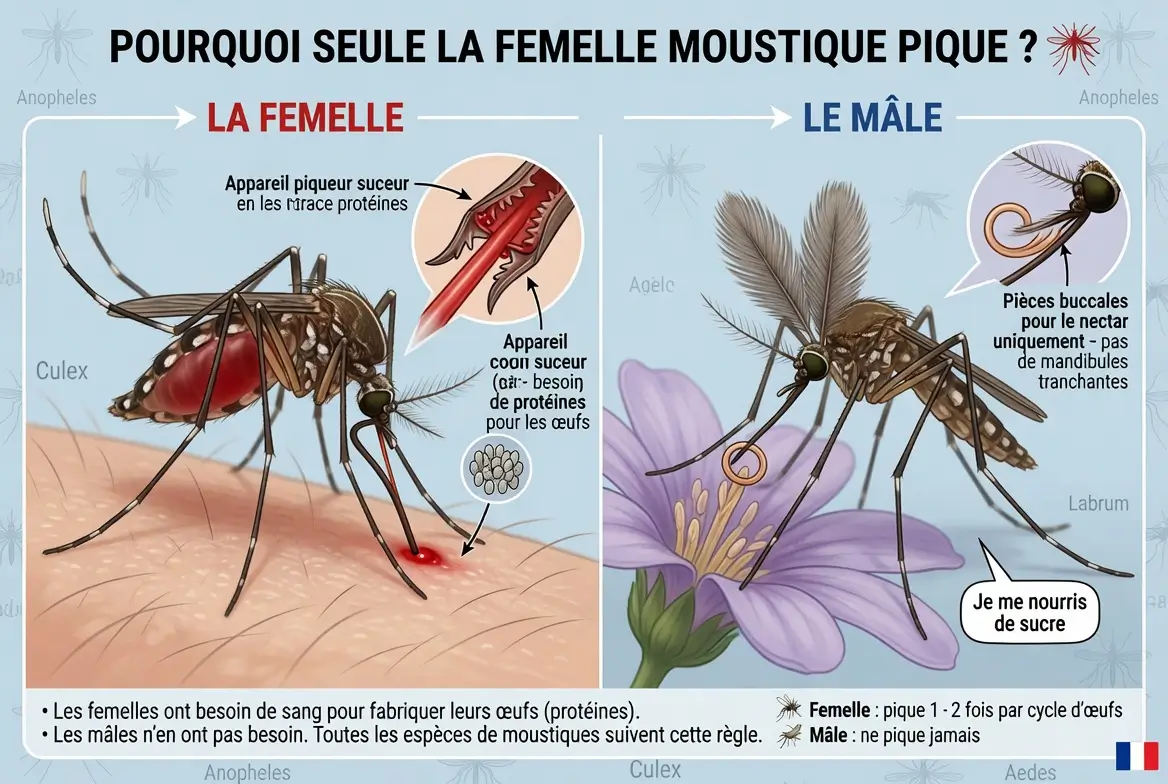
Why Only Female Mosquitoes Bite: The Biology Explained
If one seeks to understand why a mosquito bites, it's important to first clear up a common misconception: only females bite, and they do so only when they are in their reproductive phase. Of the 3,500 mosquito species identified worldwide, approximately 200 are anthropophilic, meaning they are preferentially attracted to human blood.
Human blood contains proteins, iron, and amino acids essential for egg maturation. A female needs approximately 5 microliters of blood per meal, which is two to three times her own body weight. Without this blood meal, her ovaries cannot develop the eggs to maturity. It is therefore a strict physiological necessity, not an opportunistic behavior.
After each successful bite, the female retreats for 2 to 3 days to digest the blood and produce between 100 and 300 eggs, which she will lay in stagnant water. Then the cycle begins again. A female lives an average of 4 weeks in summer and can bite 5 to 10 times during her life. To understand the entire process, consult our detailed guide on the mosquito life cycle.
This biology also explains why mosquitoes bite more at certain times: dawn and dusk are when females actively seek a host, as the cooler temperatures reduce dehydration and the low light protects them from visual predators.
How do mosquitoes detect their prey?
CO₂: the long-distance detection signal
The carbon dioxide we exhale is the number one attractant signal. A female mosquito can detect a CO₂ plume up to 50 meters away thanks to specialized receptors located on her maxillary palps. When she senses a concentration greater than 0.02% above the ambient level (which is 0.04%), she enters search mode and zigzags up the plume.
A resting adult emits approximately 8 to 12 liters of CO₂ per hour. An adult engaged in physical activity (gardening, sports) can reach 30 to 40 liters per hour, three to four times more. This is one of the main reasons why we get bitten more after a jog or during a lively outdoor meal.

Lactic acid: the short-distance signature
Within 3 meters of the host, the female switches to other receptors: those that detect lactic acid, ammonia, and octenol emitted by the skin. Lactic acid is produced by sweat glands during muscle exertion. The more you sweat, the more your skin emits this signal, and the more attractive you become.
Playing children, athletes, and individuals with high metabolisms are particularly targeted. A joint study by IRBI in Tours and the University of Montpellier published in 2024 demonstrated that the amount of lactic acid on the skin could vary by a factor of 5 between two resting individuals, which largely explains the disparity in mosquito bites.
Body heat and humidity
Within one meter, the mosquito precisely locates the biting area thanks to heat. Human skin emits a thermal signature between 32 and 35 °C, slightly higher than the ambient temperature on a summer evening. The warmest areas of the body (ankles, wrists, neck) are also the most bitten because they concentrate peripheral blood circulation.
Skin humidity also plays a role: perspiration creates a humid microclimate that the mosquito detects with its hygroscopic receptors. Dry skin is significantly less attractive than clammy skin after a hot day.
Why do some people get bitten more than others?
This is undoubtedly the most frequent question when discussing why mosquitoes bite certain people more than others. The answer is multifactorial and largely determined by genetics. Here are the eight criteria that make you a prime target.
Blood type O
A Japanese study published in the Journal of Medical Entomology demonstrated that people with blood type O are bitten 83% more often than those with blood type A. Blood types B and AB fall in between. The reason: 80% of the population secretes blood markers in their sweat and breath, and mosquitoes detect these markers from a distance. Blood type O emits the most attractive signature.
Basal metabolism and body size
Tall individuals, pregnant women (who emit 21% more CO₂), and overweight individuals are more targeted. The more oxygen you metabolize, the more CO₂ you exhale, and the more you attract mosquitoes from a distance.
Alcohol Consumption
Just one 33cl beer significantly increases your attractiveness to mosquitoes. Ethanol alters sweat composition, slightly raises skin temperature, and accelerates heart rate, thus increasing CO₂ production. Several studies agree on a 15 to 20% increase in bite rates after alcohol consumption.

Skin Microbiome
Each person's skin hosts hundreds of bacterial strains that convert sweat into volatile compounds. Some bacteria produce highly attractive odors (isovaleric acid, ammonia), while others produce repellent compounds. This bacterial signature is largely inherited and stable over time, which explains why people are bitten similarly at 20 and 50 years old.
Dark Colors
Mosquitoes are crepuscular insects that better detect dark colors against a light background. Black, dark red, navy blue, and dark green increase your visibility. Conversely, white, pale yellow, and beige reduce your visual detection by 30 to 40%.
Hormonal Factors
Pregnant women, women during ovulation, and adolescents experiencing hormonal surges show increased attractiveness. Progesterone and growth hormones slightly alter skin pH and sweat composition, making olfactory signals more pronounced.
Diet
Contrary to popular belief, garlic and vitamin B1 have no scientifically proven repellent effect. However, diets rich in bananas (potassium), beer, and fermented cheeses slightly increase attractiveness. Balanced, water-rich diets reduce the intensity of signals emitted by the skin.
Recent Physical Activity
Half an hour after exertion, your body continues to produce additional lactic acid and CO₂. This is the window of maximum vulnerability. Extended gardening, a twilight jog, or a tennis match make you a prime target for 30 to 60 minutes after the activity.
Why do mosquitoes bite certain body parts?
Mosquitoes don't bite randomly: they choose areas where the skin is thin, blood vessels are close to the surface, and heat is highest. Ankles, wrists, neck, scalp, and elbows alone account for over 65% of bites on an adult wearing shorts and a t-shirt.
Ankles are particularly targeted because they concentrate butyric acid and isovaleric acid produced by the feet. These two compounds are among the most powerful attractants known for the tiger mosquito. That's why simply washing your feet before an evening on a patio can significantly reduce the number of ankle bites.
Areas covered by thin clothing (linen, light cotton) are not protected: a mosquito's proboscis measures 1.5 to 2 mm and easily penetrates thin fabric. To understand how researchers study these behaviors, consult the work of the CNRS Strasbourg on the olfactory receptors of diptera.
Summary Table: 8 factors explaining why mosquitoes bite one person over another
How to leverage this biology for protection?
Understanding why mosquitoes bite paves the way for protection strategies far more effective than traditional repellents. The logic is simple: if you know what attracts them, you can either reduce your own attractive signature or create a lure elsewhere that is even more attractive than you.
Reducing your personal signature. Opt for light-colored, loose-fitting clothing, shower after physical activity to remove lactic acid, limit alcohol consumption outdoors in the evening, and avoid sweet or floral perfumes that amplify attractiveness. These simple measures can halve the number of bites received in an evening.
Creating a more attractive lure. This is exactly the principle of the biomimetic trap. Garden Reclaimer's GRéco unit replicates the human signal (CO₂ + heat + humidity + olfactory compounds) to intercept females before they reach your living area. The mosquito cannot differentiate between your breath and the trap's plume: it follows the strongest signal, which is calibrated to be 10 to 15 times stronger than that of a human at rest. For a complete explanation of how it works, visit the GRéco technologypage.
Effectiveness relies on intelligent placement: the unit is positioned between the breeding area (dense hedge, water source) and your patio, 10-15 meters from the living area. Mosquitoes caught at this location will never reach your skin. This approach is particularly suitable for individuals and families who want to enjoy their outdoor space without chemical repellents.

Why does a mosquito sometimes bite without us noticing?
The painless bite is a masterpiece of evolution. When the female inserts her proboscis into the skin, she simultaneously injects saliva containing local anesthetics, anticoagulants, and vasodilators. This saliva serves three purposes: preventing coagulation to draw blood faster, dilating capillaries to increase blood flow, and anesthetizing the area to avoid triggering a defense reflex.
The meal lasts 2 to 4 minutes, during which the mosquito draws 2 to 5 microliters of blood. If undisturbed, the female flies away full and heavy, barely able to fly in a straight line. It is only several minutes after her departure that the allergic reaction appears: itching, wheal, redness. These symptoms are caused by your body's immune response (histamine) to the injected saliva, not by the bite itself.
This allergic reaction varies greatly from person to person and from species to species. The tiger mosquito (Aedes albopictus) often causes more pronounced reactions than the common mosquito (Culex pipiens) because its saliva contains more allergenic proteins. Children and the elderly show the most visible reactions, while highly exposed adults often develop partial tolerance, which reduces the intensity of itching.
Why do mosquitoes bite more in the evening and at night?
The circadian rhythm of mosquitoes is closely linked to light, temperature, and humidity. Most French species (Culex pipiens, Culex modestus) are crepuscular and nocturnal: they become active at sunset, reach their peak activity 1 to 2 hours after nightfall, then calm down around 2-3 AM.
The tiger mosquito (Aedes albopictus), responsible for the majority of bites in urbanized areas of southern France, is an exception: it is a diurnal species that bites mainly at dawn and dusk, but can also bite in the middle of the afternoon in shaded areas. This characteristic makes it a particularly bothersome mosquito because it attacks humans during outdoor leisure hours, unlike its nocturnal cousins.
The peak of evening bites is also explained by our behavior: meals on the patio, light clothing, exposed skin, alcohol consumption, residual sweat from the day. All these factors converge to make summer dinner the moment of maximum vulnerability. Activating a GRéco unit 30 minutes before aperitif time allows for the establishment of an attractive plume that diverts mosquitoes from the table even before guests settle in.
FAQ: Why mosquitoes bite
Why do mosquitoes bite human females more often than males?
Female mosquitoes bite human males and females indiscriminately. However, certain physiological factors can make women more attractive at specific times: pregnancy increases CO₂ production by 21%, ovulation alters skin pH, and certain perfumes or cosmetics amplify olfactory signals. Conversely, overweight or very muscular men emit more body heat and CO₂, which also increases their attractiveness. Ultimately, the difference between men and women is small compared to variations related to blood type, genetics, and recent physical activity.
Why does a mosquito bite me and not my neighbor?
Three main factors explain this difference: blood type (people with type O are bitten 83% more than those with type A), skin microbiota (each person's skin hosts bacteria that produce more or less attractive odors), and metabolism (the more CO₂ you exhale, the further away you can be detected). In addition to these criteria, there are adjustable factors such as clothing color, alcohol consumption, recent physical activity, and perspiration. If you are consistently bitten more than those around you, you likely combine several of these factors. A CO₂ trap like the GRéco terminal neutralizes this inequality by attracting mosquitoes to itself rather than to you.
Why do mosquitoes bite and leave an itch?
The itch is not caused by the bite itself but by the saliva injected by the mosquito to anesthetize the area and thin the blood. This saliva contains anticoagulant proteins that your immune system identifies as allergens. Your body then releases histamine, which causes the characteristic red welt and itching. The intensity of the reaction varies depending on individual sensitivity and mosquito species: tiger mosquitoes often cause stronger reactions than common mosquitoes. Children and individuals with little exposure react more violently than accustomed adults.
Why do mosquitoes bite through thin clothing?
A mosquito's proboscis is 1.5 to 2 millimeters long and rigid enough to penetrate thin fabric like a light cotton t-shirt, thin leggings, or a linen shirt. If the fabric is pressed against the skin (tight sleeve, close-fitting leg), the mosquito lands on the fabric and directly inserts its proboscis through it. To effectively block bites, opt for tightly woven fabrics, loose-fitting clothing that creates a space between the fabric and the skin, and light colors that reduce your visual detection. Permethrin-treated clothing offers additional protection, but its use is regulated.
Why do mosquitoes bite when you are still?
Mosquitoes primarily bite when you are still because that's when they can precisely locate the biting area without risking a reflexive movement from you. When you move, air currents disrupt their olfactory receptors, and your skin's stable thermal signature is harder to pinpoint. During sleep, your body temperature remains constant, and your breathing emits a continuous plume of CO₂, making you an ideal target. Evenings on the terrace, seated aperitifs, and warm nights with open windows represent the three situations of maximum vulnerability. A GRéco terminal continuously activated during these times intercepts females before they reach you.
Why does a mosquito bite me multiple times in a row?
A single female can bite multiple times in a few minutes if she is disturbed during her meal. If you shoo her away without killing her, she will land 30 cm further away and resume where she left off. This is why you sometimes find several bites grouped on the same ankle or arm. Once satiated, she will hide for 2 to 3 days to digest and lay eggs. If you are bitten 5 or 6 times in an evening, it's usually by 5 or 6 different females attracted by your personal signature. To get personalized advice on protecting your garden, contact the Garden Reclaimer team.
Are repellent essential oils effective against bites?
The effectiveness of essential oils (citronella, lemon eucalyptus, geraniol, lavender) is real but limited in time and space. They work by saturating the mosquito's olfactory receptors and temporarily masking your personal signature. However, the protection does not exceed 1 to 2 hours and is limited to a radius of 1 to 2 meters around the diffused area. According to the work of theIRBI of Tours, these solutions are suitable for occasional use (meals on the terrace) but do not replace a comprehensive strategy combining larval habitat suppression and active trapping.