



The mosquito repellent plants have long appealed to gardeners who want to enjoy their outdoor spaces without chemical sprays. However, there can be a significant gap between marketing promises and real-world effectiveness. At Garden Reclaimer, creators of the mosquito trap GRéco, developed in partnership with the CNRS of Strasbourg, we test these plants each season in addition to our biomimetic traps. This guide reviews the 12 species whose effectiveness has been validated by research, detailing for each its active compound, measured effective range, and the best way to incorporate them into a garden.
The principle is simple, but often misunderstood. A repellent plant does not keep mosquitoes away simply by its presence. It releases volatile organic compounds—terpenes, aldehydes, or alcohols—that disrupt the olfactory receptors of blood-seeking females. However, these molecules evaporate very gradually from intact leaves. To achieve a repellent effect, you must therefore crush the foliage or expose it to strong sunlight that heats the essential oils. Without this stimulation, mosquito repellent plants only release a fraction of their potential.
A study published on PubMed in 2018 compared the repellent effect of 41 aromatic plants on Aedes albopictus, the tiger mosquito. The findings are conclusive: no single plant achieves the effectiveness of professional protection, but some reduce bites by 30 to 50% within a close radius. It is this cost-benefit, ecological, and sensory balance that makes these plants relevant in a global strategy.
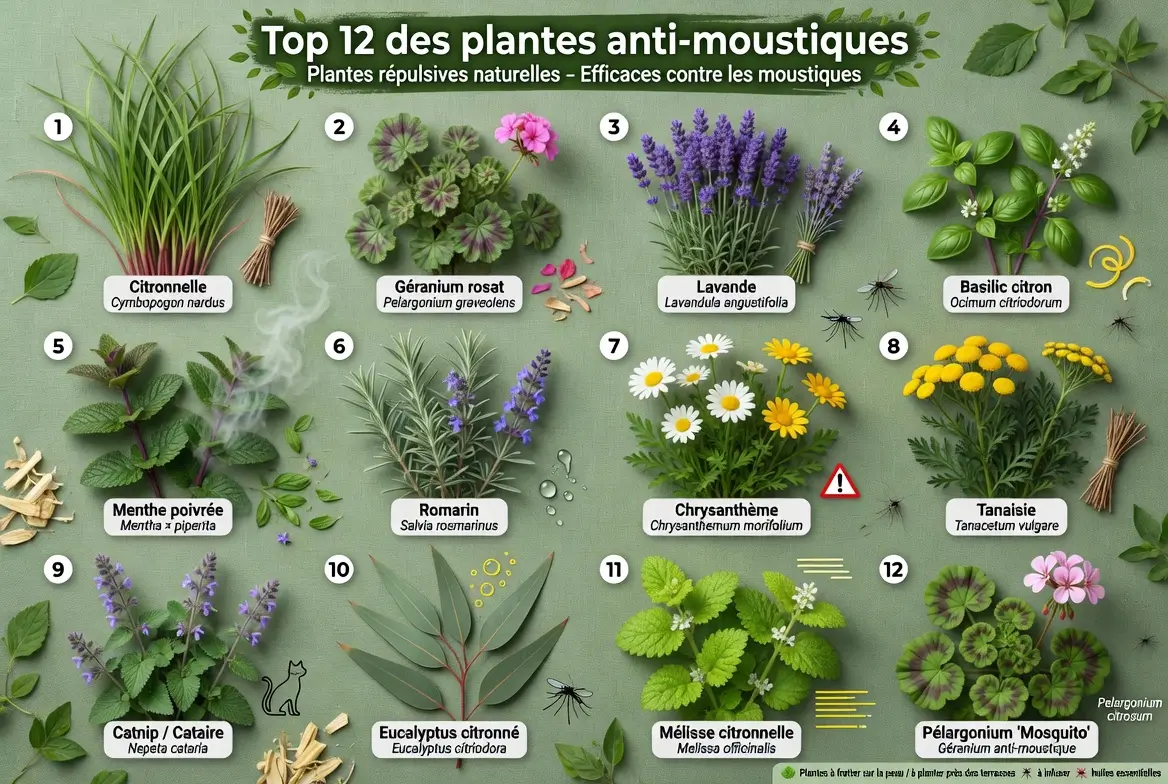
Top 12 Scientifically Validated Mosquito Repellent Plants
Here are the 12 species that release the most well-documented active compounds for mosquito repulsion. The list is based on publications referenced by PubMed, INRAE, and the Institute for Research on Insect Biology (IRBI Tours), institutions that partner in numerous entomological studies in France.
Citronella, Geranium, and Lavender: A Closer Look at the Classics
Java citronella (Cymbopogon nardus) is undoubtedly the first plant associated with mosquito control. Its essential oil contains up to 40% citronellal and 25% geraniol, two molecules whose repellent effect has been documented since the 1990s. However, the oil diffused by intact leaves represents only a tiny fraction of the concentration applied in solution to the skin. This is why a single citronella plant only protects a radius of 1 to 2 meters, and only in warm, calm weather.
The Scented geranium (Pelargonium graveolens, or citronellum) is often confused with citronella because it emits a very similar scent. Its flower releases comparable amounts of citronellol and geraniol, but the plant is more readily available in garden centers and hardier in our climates. It thrives in pots or in the ground in temperate regions and is highly resistant to summer drought. To maximize its effect, plant several specimens along the edge of a terrace or window.
True lavender (Lavandula angustifolia) is the pride of Mediterranean gardens, but its repellent properties are more modest than those of the previous two. Its main active compound is linalool, accompanied by linalyl acetate. A study published in 2014 in the Journal of Insect Science showed a 25 to 35% reduction in the number of bites in an area protected by a mass of flowering lavender. The effect is maximal between June and August, when the essential oil concentrates in the flowers.
Catnip and lemon eucalyptus: the true champions
Among mosquito repellent plants, two species stand out significantly due to the potency of their active compound. The first is catnip (Nepeta cataria), also known as catmint. A study by Iowa State University published on PubMed demonstrated that nepetalactone, a compound specific to this plant, is 10 times more repellent than DEET (the active ingredient in synthetic repellents). In practice, a well-exposed patch of catnip reduces bites by 50 to 70% within a 1 to 2-meter radius. The only drawback is that its scent attracts neighborhood cats, who love to roll in it.
The second islemon eucalyptus (Corymbia citriodora), whose essential oil contains p-menthane-3,8-diol (PMD), a molecule recognized by the WHO and the French Agency for Food, Environmental and Occupational Health & Safety (Anses) as one of the only effective natural repellents against Aedes albopictus. PMD targets the same olfactory receptors as DEET, but with a much more favorable toxicological profile. A lemon eucalyptus planted along a terrace, either as a small tree or a trimmed bush, diffuses its scent over 2 to 3 meters in warm weather.
These two species share a common characteristic: they release their volatile compounds at significantly higher concentrations than other aromatics, which explains their longer range. To learn more about validated natural solutions, consult our article onscience-backed natural mosquito repellent, which lists all non-chemical approaches.

Basil, lemon balm, mint: aromatics useful in the kitchen
The basil (Ocimum basilicum) plays a dual role in the garden. In the kitchen, it enhances summer salads. Planted near a patio, it releases eugenol and linalool, which reduce mosquito attraction by 30 to 45%. Basil thrives in full sun and requires regular watering. A tip: prune it often to stimulate the production of essential oils in young shoots, which are more concentrated than older leaves.
Lemon balm (Melissa officinalis) is a cousin of mint and emits a characteristic lemony scent. Its citral, making up 60% of its essential oil, disrupts mosquito antennae. Lemon balm grows easily in partial shade and resists being overtaken by other herbs. Plant it near a bedroom window or front door to enjoy its fragrance as you pass by.
Peppermint mint (Mentha piperita) is even hardier. Its menthol and menthone act at short distances, within 30 to 60 cm around the plant. It's an ideal companion for vegetable garden borders and shaded flowerbeds. Be aware, however, that mint is invasive: plant it in a buried pot or define its area with a rigid border to prevent it from colonizing the entire garden. For a comprehensive approach to garden protection, our guide on how to repel mosquitoes details the ideal outdoor setup.
Marigolds, rosemary, lemon thyme, monarda: vegetable garden companions
Marigolds (Tagetes patula) (French marigolds, Tagetes patula) have long been used as companion plants in vegetable gardens. Their roots secrete thiophenes that repel soil nematodes, but their flowers also emit limonene and terthiophene, two compounds that deter mosquitoes within 50 cm to 1 m. Planted alongside tomatoes or zucchini, they contribute to the health of the vegetable patch while reducing the presence of biting insects.
Rosemary (Salvia rosmarinus) (Salvia rosmarinus) is one of the best choices for dry Mediterranean gardens. Its 1,8-cineole and camphor release a powerful scent in warm weather. Its repellent effect peaks during heatwaves when essential oils evaporate intensely. A specific advantage: rosemary remains evergreen all year, providing continuous protection, unlike most other aromatic plants.
Lemon thyme (Thymus citriodorus) combines two active compounds: geraniol (common with citronella) and the rarer thymol. This combination gives it an interesting repellent effect on female Aedes albopictus mosquitoes. Monarda (Monarda didyma) (Monarda didyma), finally, blooms in decorative red or pink clumps while releasing thymol and carvacrol. It fits perfectly into an English-inspired flower bed. All these mosquito-repelling plants offer a dual benefit: decorative or culinary on the one hand, and repellent on the other.
How to create an effective mosquito-repelling flower bed
A single repellent plant is not enough to protect a patio. The winning strategy is to create a multi-species flower bed that combines active compounds and extends the effect throughout the season. Here are the principles we apply in partnership with the landscapers who install the GRéco terminal.
Prioritize complementary active compounds. Combine a plant rich in citronellal (citronella, geranium), a plant rich in linalool (lavender, basil), and a plant rich in thymol or carvacrol (thyme, bee balm). This molecular diversity increases repellent coverage and limits habituation, as mosquito populations adapt more slowly to a cocktail than to a single molecule.
Pay attention to planting density. An effective flower bed should have at least 6 to 8 plants per square meter for aromatic perennials. Plant densely to encourage root competition, which stimulates essential oil production. A lavender plant isolated in the middle of a lawn will never release as much as a lavender planted within a strip of 30 plants.
Position the flower bed intelligently. Place it between mosquito resting areas (dense hedges, undergrowth) and your living area (patio, garden lounge). The flower bed then acts as an olfactory filter. Also consider the direction of the prevailing wind: a flower bed downwind directs its scent towards the area to be protected, whereas a flower bed upwind loses most of its effect.
Activate the scent by contact. Regularly running your hand over the leaves or lightly pruning them releases more essential oils. Create a path bordered by low-growing plants (thyme, mint, lavender) that your legs brush against, which effortlessly stimulates the emission of volatile compounds.

The limitations of mosquito-repelling plants in 2026
Let's be clear: no mosquito-repelling plant, whether isolated or even in a flower bed, can fully protect a garden. Studies agree on this point. A systematic review published by INRAE in 2022 concluded that unextracted plant-based repellents reduce bites by 20 to 40% on average, compared to 80 to 95% for a synthetic repellent applied to the skin. This is useful, but insufficient for a family with children or an area with high tiger mosquito pressure.
Mosquito-repelling plants suffer from three structural limitations. Firstly, their diffusion is passive: they continuously release their compounds but at very low concentrations. Secondly, their range is short, from 30 cm to a maximum of 3 m depending on the species and conditions. Finally, they have no effect on already engorged females seeking an egg-laying site, nor on males, nor on the larval cycle in water.
To understand why an entire garden cannot be protected by plants alone, we need to look at the biological cycle. A female lays between 100 and 300 eggs, and the population can multiply tenfold in 14 days in warm weather. The mosquito repellent plants act downstream, on the attraction phase, but do not break the reproduction dynamic. It is this dynamic that must be interrupted to achieve a real reduction in the population.
Repellent Plants + GRéco CO₂ Trap: the winning combination
This is precisely where the complementarity with an active mosquito trap comes in. The GRéco, designed by Garden Reclaimer in partnership with the CNRS in Strasbourg and IRBI in Tours, reproduces the biomimetic signal of a mammal: atmospherically concentrated CO₂, heat, humidity, and pheromones. This plume attracts females from several tens of meters away, covering up to 2,000 m² per device. The mosquitoes are then sucked into a net where they dehydrate.
Repellent plants and the trap work synergistically on two distinct behavioral phases. Plants disrupt close-range olfaction, within a 30 cm to 3 m radius around the living area. The trap, on the other hand, attracts and captures females from long distances, intercepting those that have not yet detected their target. The results in the field are measurable: users who combine a repellent plant bed and a GRéco trap report a 90 to 95% reduction in bites after 6 to 8 weeks, compared to 30 to 50% with plants alone.
A key advantage for gardeners: the GRéco does not disturb the floral ecosystem. The CO₂ + pheromone plume only targets hematophagous dipterans. Bees foraging on lavender, butterflies resting on monarda, and bumblebees clinging to basil are never captured. More than 98% of the catches in the net are mosquitoes or biting midges, which are also biting species. Discover the detailed operation on the page of the GRéco solution, or explore uses for private gardens.
Mosquito Repellent Plant Installation Calendar
Installation timing strongly influences seasonal effectiveness. Here is the schedule to follow for a plant bed that is operational from the first warm days.
March-April : soil preparation and planting of perennials (lavender, rosemary, thyme, lemon balm, mint, monarda, catnip). Take advantage of still-moist and cool soil to promote rooting before summer heat. Plant seedlings purchased in pots or 2-liter containers, and water generously for the first few weeks.
May : planting of annuals and frost-sensitive plants (basil, scented geranium, Java citronella, marigolds, potted lemon eucalyptus). These species are sensitive to frost and should wait until after the "Ice Saints" (mid-May in northern France). This month also corresponds to the peak catches for the GRéco trap launched 4 to 6 weeks earlier.
June-August : regular maintenance. Prune the leaves, water sparingly, and remove faded flowers. Regularly trim basil and mint to encourage new growth. Take advantage of the period when essential oils are at their maximum concentration, under the effect of heat and light.
September-October : harvest and storage. Prune perennials before winter. Dry bouquets of lavender, rosemary, and thyme for indoor use. Bring potted citronella, geranium, and lemon eucalyptus indoors to a conservatory or frost-free room. It's also time to think about future arrangements: if mosquito pressure has been high despite the plant bed, it's likely that a CO₂ trap should be added. Request personalized advice for the next season.
FAQ: Mosquito Repellent Plants
Which mosquito repellent plants are most effective in 2026?
The most effective mosquito repellent plants validated by research in 2026 are catnip (Nepeta cataria), with nepetalactone 10 times more repellent than DEET according to Iowa State University, and lemon eucalyptus (Corymbia citriodora), whose p-menthane-3,8-diol is recognized by the WHO and Anses. Next are Java citronella, scented geranium, and basil, which reduce bites by 30 to 50% in a close radius. No single plant matches the performance of a CO₂ trap like the GRéco station, but the combination of a plant bed + trap offers the best results: 90 to 95% reduction over 2,000 m².
Is one mosquito repellent plant enough to protect my patio?
No. A single plant, even a well-chosen one, only releases volatile compounds over a maximum of 30 cm to 3 m, and its effect significantly decreases in cool or windy weather. A dense bed of 6 to 8 plants per square meter, composed of several complementary species (citronella, lavender, basil, monarda), increases coverage but does not exceed 30 to 50% reduction in bites. For a fully protected patio, combine this plant bed with a CO₂ trap that intercepts females from a long distance before they reach the living area. This combination is the only one to offer protection comparable to a chemical repellent without any synthetic products.
Are mosquito repellent plants dangerous for bees?
No, it's actually one of their great advantages. The volatile compounds emitted by repellent plants (citronellal, geraniol, linalool, thymol) target specific mosquito olfactory receptors. They do not affect pollinators like bees, bumblebees, and butterflies, which continue to forage on flowers undisturbed. On the contrary, lavender, monarda, basil, and lemon balm flowers are among the most visited by bees. A mosquito repellent plant bed therefore contributes to both your comfort and garden biodiversity, provided chemical pesticides are also banned.
Do you need to crush the leaves to activate the repellent effect?
Yes, in part. Intact leaves continuously release their volatile compounds, but at a very low concentration. When you crush a citronella, mint, or basil leaf, you break the cells containing the essential oils and trigger a concentrated emission for a few minutes. This is why it's advisable to place mosquito repellent plants along pathways where legs might brush against them, or in pots near chairs where people move around. The sun's heat also plays a role: in warm, calm weather, the passive evaporation of essential oils increases by 3 to 5 times, which explains their maximum effectiveness in mid-summer.
Which mosquito repellent plants can be potted on a balcony?
Several species are perfectly suited for pot cultivation. Scented geranium, Java citronella, basil, lemon balm, peppermint, and lemon thyme yield excellent results in pots at least 30 cm in diameter, filled with well-drained potting soil. Lavender also tolerates pots but requires a larger container (40 cm) and dry substrate. Lemon eucalyptus can be grown in a large pot (50 cm), and should be brought indoors in winter in northern France. For a balcony, arrange 4 to 6 pots of different species along the railing. This small aromatic planter reduces mosquito pressure by 25 to 40% and pleasantly scents the area, especially in the early evening when insects are most active.
What role do mosquito repellent plants play against the tiger mosquito?
The tiger mosquito (Aedes albopictus) is now present in over 80 French departments in 2026. It is more aggressive and more active during the day than the common mosquito, which complicates protection. Mosquito repellent plants have partial effectiveness against it: lemon eucalyptus and catnip remain the most active thanks to PMD and nepetalactone. However, the tiger mosquito, primarily attracted by CO₂ and body heat, easily bypasses plant-based olfactory barriers. For serious protection against this species, it is essential to combine the repellent plant bed with a biomimetic CO₂ trap. The GRéco station, through its complete simulation of the human signal, specifically captures female Aedes albopictus from a long distance and breaks their reproductive cycle.


.webp)