

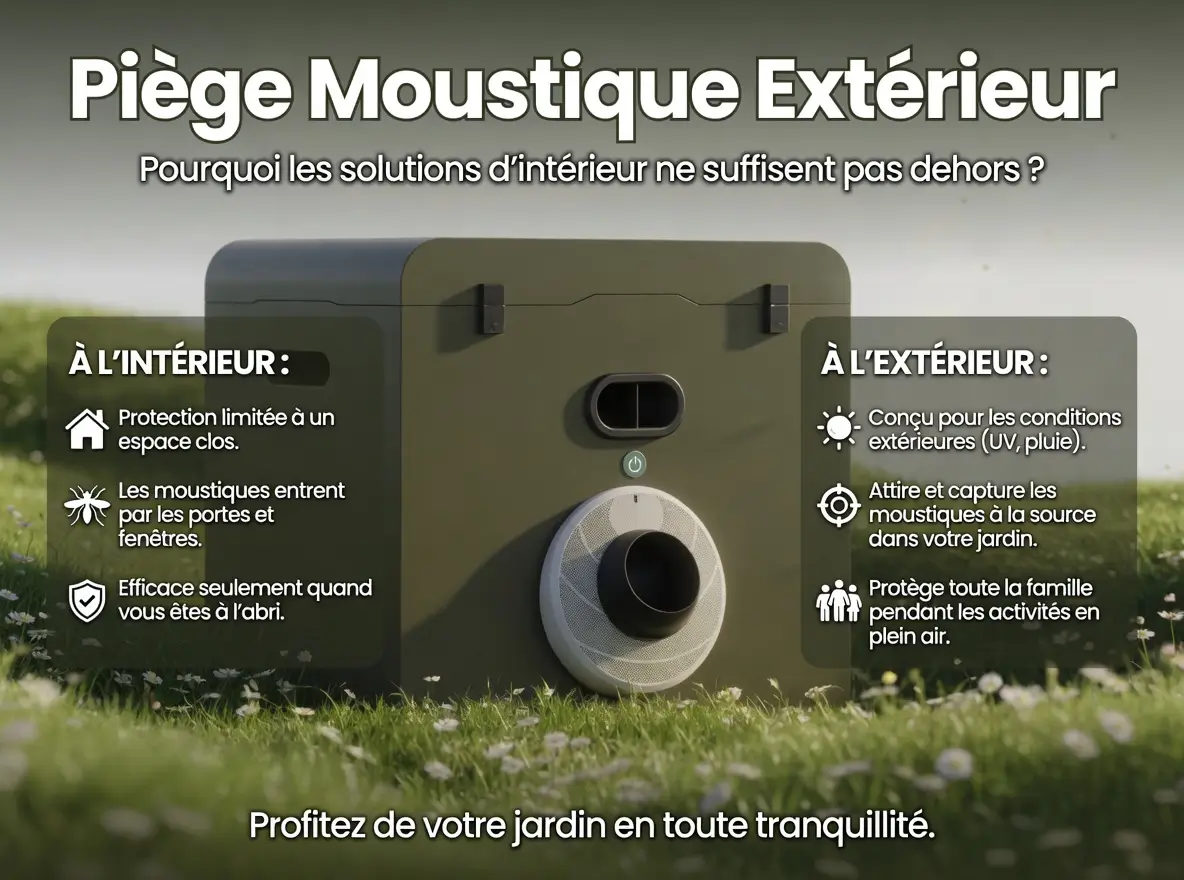
Install a outdoor mosquito trap efficient has become a priority for anyone who wants to enjoy their garden without being bitten. At Garden Reclaimer, designer of the Mosquito repellent terminal GréCo, we observe a recurring error: many owners try to use devices designed for indoor use outside (mosquito sockets, electric diffusers). The results are invariably disappointing.
In the open air, the constraints are radically different. Wind disperses chemical repellents in seconds. The area to be covered is measured in hundreds of square meters, not in rooms of 20 m². Mosquitoes come from all directions from their breeding grounds (hedges, water points, gutters). An outdoor trap must therefore act at a long distance, withstand bad weather and operate continuously over several months.
This guide reviews the technologies available for outdoor use, their measured performances, and the criteria for choosing to effectively protect your outdoor living space.
One observation is obvious at the outset: mosquitoes are not simply a nuisance. They are vectors of serious diseases (dengue, chikungunya, Zika) whose indigenous cases are increasing every year in metropolitan France. In 2024, the ARS identified more than 80 cases of dengue contracted locally in Occitanie and PACA. Protecting yourself effectively outside is therefore no longer a question of comfort but also of public health.
How does an outdoor mosquito trap work?
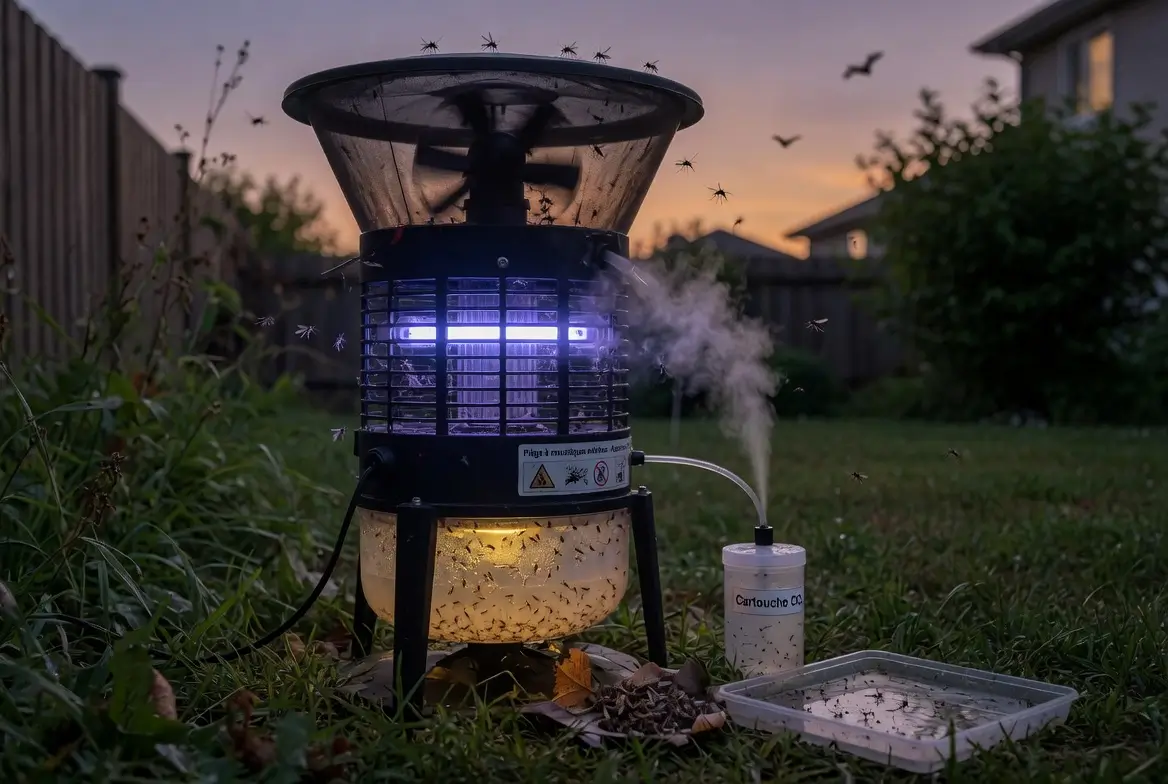
All outdoor traps are based on the same principle: attract mosquitoes to a specific point in order to catch or eliminate them before they reach people. It is the attraction mechanism that makes the difference between an effective device and a useless gadget.
Attraction by CO₂. Female mosquitoes identify their targets thanks to carbon dioxide exhaled by mammals. A trap that reproduces this signal attracts mosquitoes from several tens of meters away. It is the most effective mechanism known to date, validated by decades of entomological research. The GréCo terminal concentrates CO₂ from the ambient air to generate this signal without a gas bottle, making it autonomous and economical to use.
The attraction through heat and humidity. In addition to CO₂, mosquitoes detect body heat (infrared) and humidity from perspiration. High-end traps combine these three signals to create a very realistic lure. GréCo emits a 37°C plume with a controlled humidity level, faithfully imitating the signature of a human being.
The light attraction. UV lamps attract some flying insects, but mosquitoes are very insensitive to them. Studies show that the species captured by light traps are mostly non-biting moths and dipterans. This mechanism is therefore unsuitable as a main outdoor solution.
Mechanical capture. Once attracted, mosquitoes are retained by suction (fan), by trapping on a sticky surface or by electrocuting (high voltage grid). Fan suction, used by GréCo, is the most selective method: it only targets insects that are close enough to the airflow, sparing the large pollinators that fly higher. The sucked mosquitoes are held in a net where they dehydrate within a few hours, with no possibility of escaping. This process is silent (less than 40 dB for GréCo) and does not generate any unpleasant odors, making it compatible with use near living areas, pools, and children's play areas.
Traps with a sticky surface. Some entry-level models use adhesive plates to trap insects attracted by a visual or olfactory decoy. The effectiveness is modest outside because these plates lose their adhesive power under the effect of humidity, dust and weather. They require frequent replacement (every 1 to 2 weeks) and indiscriminately capture all insects that land on them. This solution is mainly used in agricultural greenhouses and food warehouses, rarely in a residential context.
Outdoor mosquito trap: a comparison of technologies
This comparison evaluates each type of trap on its real performance in outdoor conditions. The positioning of GréCO in first place reflects its technological advance in the category of autonomous CO₂ traps.
One point deserves particular attention: photocatalytic traps. Sold between €20 and €80 in supermarkets, these devices use a UV lamp combined with titanium dioxide (TiO₂) to produce a micro-quantity of CO₂ by chemical reaction. While the principle is attractive, the quantity of CO₂ generated is still a hundred times less than that of a real CO₂ trap. Their radius of attraction rarely exceeds 10 meters in real conditions, making them unsuitable for standard-sized gardens. They can be used as a complement on a small covered terrace, but are not a fully-fledged mosquito control solution.
The table confirms the superiority of CO2 traps for outdoor use. The difference between GréCo and bottle traps is mainly due to autonomy: not having to replace a gas bottle every three weeks radically changes the user experience and the annual cost of operation.
Where to place your outdoor mosquito trap for optimal results
Positioning represents 50% of the efficiency of a CO₂ trap. A poorly chosen location can halve capture performance, regardless of the model used.
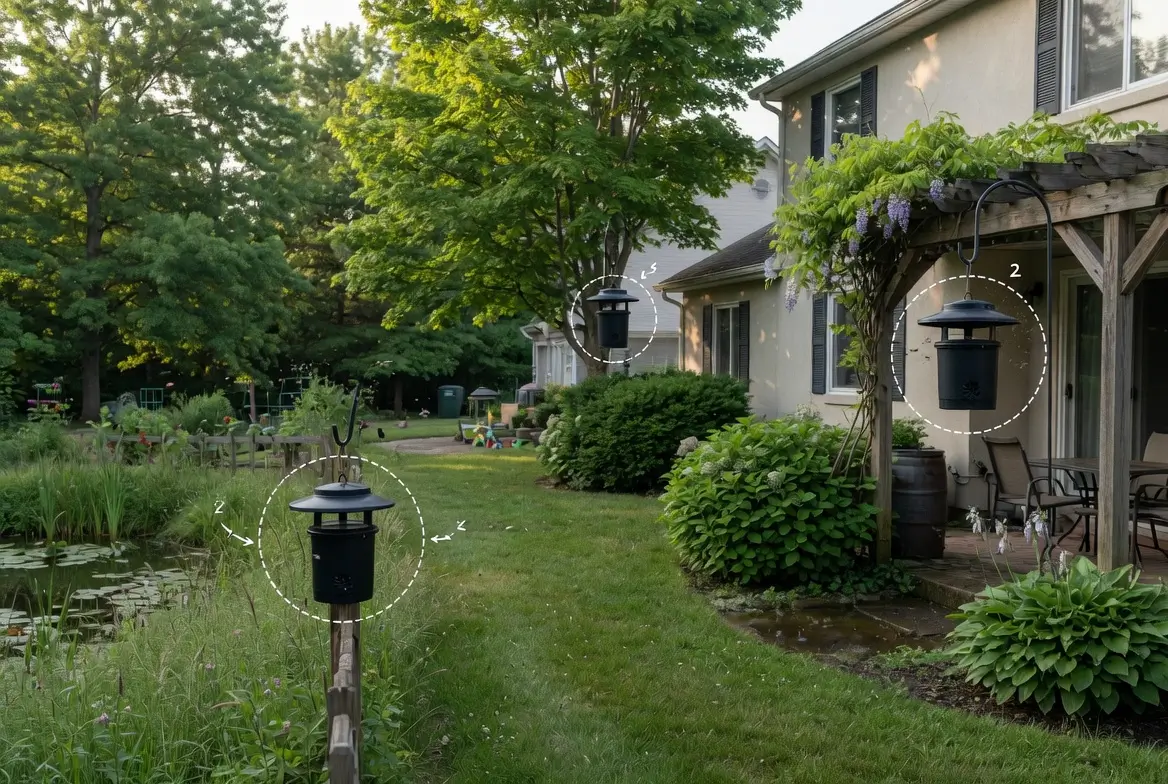
Fundamental rule: intercept, not compete. The trap should not be located next to the people to be protected. It must be positioned between mosquito rest areas (hedges, undergrowth, water points) and the living space. Thus, mosquitoes are caught during their journey to you, before reaching the terrace or pool.
Ideal distance. Place the device 10-15 meters from the area to be protected, on the side of plant beds or stagnant water. If your garden is surrounded by dense vegetation on several sides, position the trap on the wettest or shadiest side, as this is where mosquitoes concentrate during the day.
Placement height. Mosquitos mostly fly between 50 cm and 1.5 m from the ground. Raise your trap on a support of 60 to 80 cm to place the CO₂ outlet in this optimal flight band. A trap placed on the ground will see its pull be diluted to the level of the turf, reducing its effective range.
Shelter from the wind. The CO₂ plume should propagate in relatively calm air. A sustained wind (over 15 km/h) disperses the signal and reduces the attraction range. If your garden is windy, place the trap in a naturally sheltered area: behind a hedge, against a wall, or under an awning. The GréCo is designed to work with light breezes, but calm conditions significantly improve catches.
Proximity to larval sites. If your garden contains a water point (pond, pond, catcher), place the trap halfway between this water point and your terrace. Mosquitos lay eggs in standing water and adults generally stay within a radius of 50 to 200 meters from where they were born. By intercepting females between their breeding area and your living space, you maximize the impact on the local population. To learn more about eliminating breeding sites, see our detailed article on The mosquito larval cycle.
For complex configurations (sloping ground, long garden, presence of a body of water), Request a free mesh diagnosis with the Garden Reclaimer team. Optimized placement can mean the difference between 70% and 95% in savings.
Maintaining an outdoor trap: best practices
A well-maintained trap maintains its performance throughout the season. A neglected trap gradually loses its effectiveness. Here is the recommended maintenance schedule for the GréCO terminal and CO₂ traps in general.
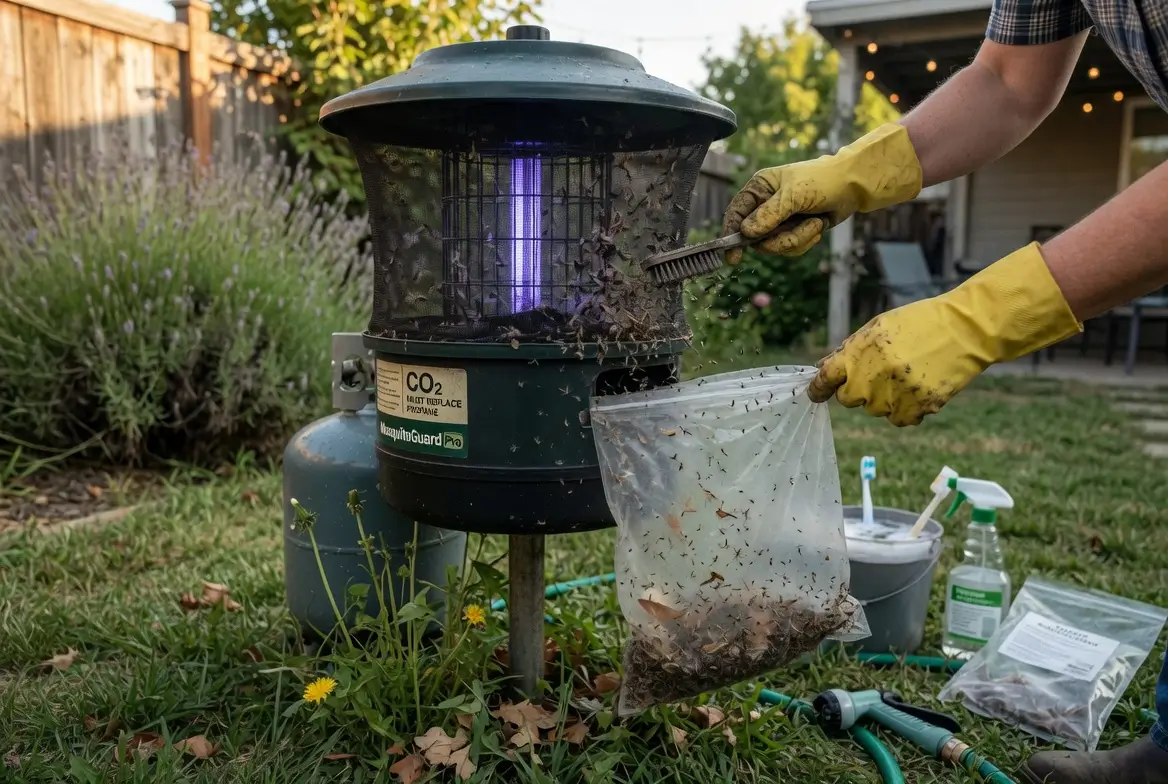
Every 2 to 4 weeks: empty the catch net. Captured mosquitoes dehydrate in the net. When it fills up, the airflow may be partially obstructed, reducing suction. Turn the net over a trash can and rinse it off with clean water if necessary. The operation takes less than two minutes.
Every 2 to 3 months: clean the entrance grill. Spider webs, fallen leaves, and dust can obstruct the entrance to the trap. A soft brush or compressed air stroke is enough to restore optimal airflow. Also check that the fan is running freely and without abnormal noise.
Once per season: replace the liquid attractant. GréCo uses a pheromonal lure that gradually loses its attractive power over the months. The annual replacement (included in the running cost of €50-100) guarantees a maximum attraction signal throughout the season.
At the end of the season: wintering. When nighttime temperatures drop below 10°C on a regular basis (October-November depending on the region), mosquitoes enter into a diapause. Unplug the trap, clean it thoroughly, empty and dry the catch net, and store the set in a dry, temperate place. Proper wintering extends the life of the device by a factor of two. The following spring, perform a quick check before returning to service: condition of the power cable, cleanliness of the fan, integrity of the catch net. Order your attractant refill in advance to be operational from the first heat.
Care tip. Keep a catch tracking log. Note the approximate volume of mosquitos collected each time the net is emptied. This data will allow you to identify seasonal peaks in activity, adjust the positioning of the trap if necessary, and verify that the effectiveness is maintained from one year to the next. The GréCo connected terminal offers this functionality in a digital version via its mobile application, with real-time capture statistics and maintenance alerts. To learn more about the seasonal behavior of mosquitoes, check out our article on The life cycle of larvae.
Outdoor mosquito trap and biodiversity: a compatible duo
A legitimate concern concerns the impact of traps on beneficial insects. Are pollinators (bees, bumblebees, butterflies) threatened by an outdoor device? The answer depends on the technology used.
UV lamps are the most destructive for biodiversity: they attract and kill all nocturnal insects indiscriminately, including many pollinators and biological control agents (lacewings, hoverflies). Their negative impact on entomofauna has been documented since the 1990s.
CO₂ traps, on the other hand, are highly selective. Only blood-sucking insects (which feed on blood) are attracted to the CO₂ + pheromone signal. Bees, butterflies, and beetles don't respond to this stimulus. Capture surveys carried out on the GréCo terminal show that more than 98% of the trapped insects are mosquitoes (Aedes, Culex, Anopheles) and related species (blackflies, ceratopogonids). The impact on pollinators is negligible.
It's also important to note that CO₂ traps don't disrupt local food chains. Captured mosquitoes represent a minimal fraction of the total insect biomass in a garden. Swallows, bats, and dragonflies keep most of their prey. On the other hand, these natural predators benefit indirectly from the CO₂ trap: by reducing the mosquito population in one area, the trap concentrates the remaining specimens in other areas of the garden, facilitating natural predation.
This selectivity is an increasingly decisive argument for communities and protected natural areas, where traditional insecticide treatments (deltamethrin or Bti sprays) are increasingly contested. To learn more about species identification, check out our guide on The tiger mosquito.
FAQ: outdoor mosquito trap
Does an outdoor mosquito trap work in the rain?
Traps designed for outdoor use, such as the GréCo terminal, are waterproof (minimum IP44 standard) and work in the rain without problems. Water does not interfere with the CO₂ attraction mechanism or the suction fan. On the other hand, rain naturally reduces the activity of mosquitoes: these insects avoid flying when the drops are too big. Catches resume as soon as the downpour is over, often with a peak of activity due to residual humidity in the air. No intervention is necessary in case of rain.
How many traps do you need for a large garden?
The GréCo terminal covers a radius of 60 meters, i.e. approximately 1 hectare (10,000 m²). For a standard residential garden of 200 to 2,000 m², a single trap is sufficient if properly positioned. Over 5,000 m², or for L-shaped land or with significant obstacles (buildings, high hedges), two bollards positioned in a mesh format offer complete coverage without dead zones. Garden Reclaimer offers a free diagnosis to determine the number and optimal location of terminals according to the topography of your land.
Does the trap attract more mosquitos to my home?
This is a common but unfounded fear. The trap attracts mosquitoes that are already present in your immediate environment. Its radius of attraction (60 m for GréCO) corresponds to the area in which these mosquitoes circulate naturally to find a host. By catching them before they sting you, the trap gradually reduces the local population. After 6 to 8 weeks of continuous operation, mosquito density drops from 80 to 95%. The trap does not create a mosquito “call” from neighboring properties: mosquitoes generally do not travel more than 100 to 200 meters in their lives.
What is the power consumption of an outdoor CO₂ trap?
Consumption varies depending on the model. Classic canister traps consume 30 to 50 watts, or about 20 to 35€ of electricity per season of 6 months. The GréCo terminal consumes around 40 watts during normal operation, which represents 25 to 30€ of electricity per season. This consumption is comparable to that of a high power LED bulb and represents a tiny fraction of the total cost of operation. The integrated eco mode reduces consumption by 30% during periods of low pressure (cool nights, strong wind).
Can you make a mosquito trap yourself?
Tutorials of homemade traps (cut bottle with sugar water and yeast) are widely available on the internet. These traps actually produce a small quantity of CO₂ by fermentation, but their effectiveness is negligible: 5 to 15% reduction within a radius of 1 to 3 meters. The quantity of CO₂ generated is a hundred times less than that of a professional trap, and the attraction signal does not include heat, humidity, or pheromones. These crafts can be used as a monitoring tool (checking for the presence of mosquitoes in an area), but not as a protection solution. For effective mosquito control, a professional trap remains essential.