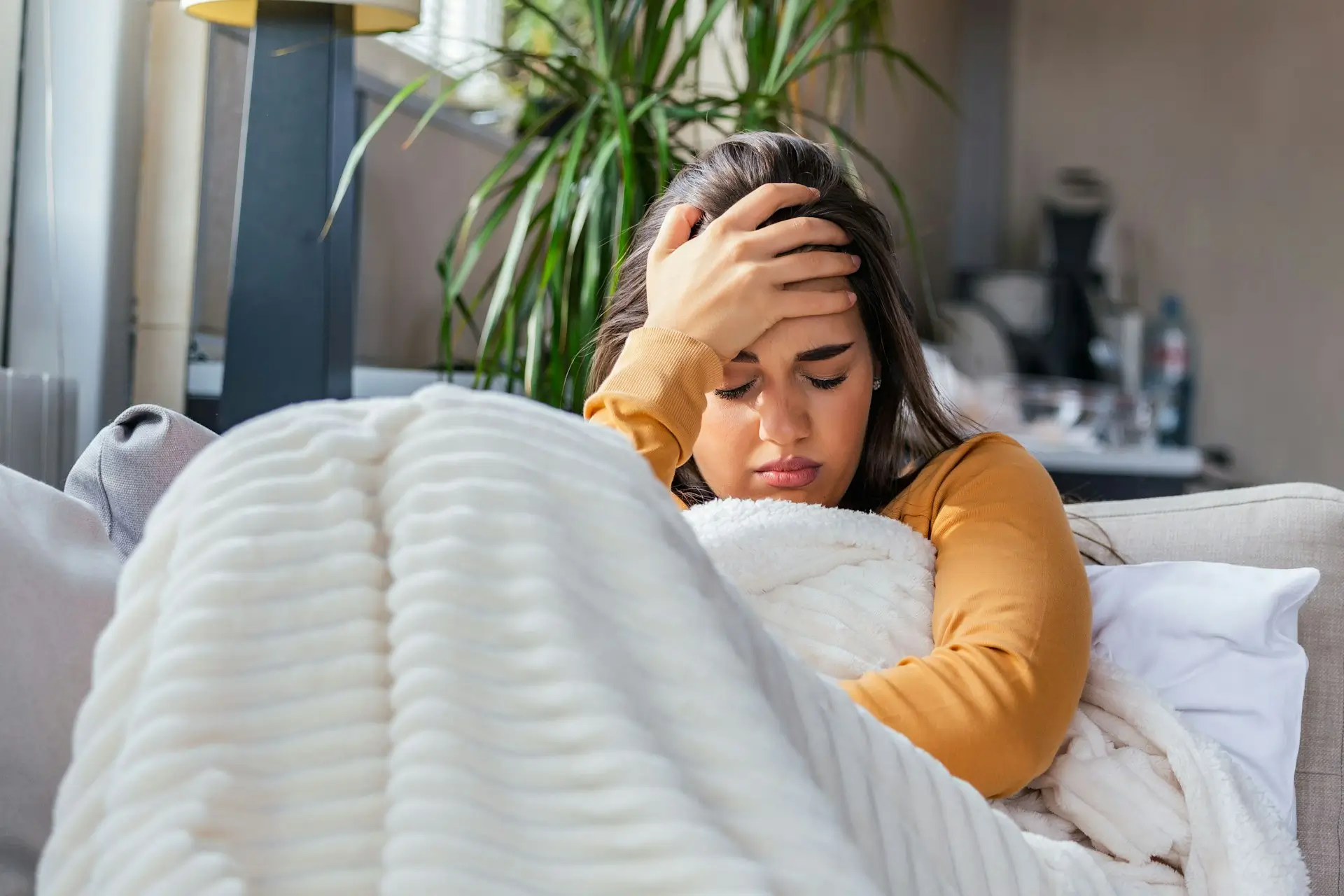



Understand How to attract mosquitos starts by decoding the chemical and thermal profile of a human at rest. Females do not move by chance: they follow a cocktail of signals emitted continuously by our body. Here are the six dominant lures identified by the laboratories of the IRBI in Tours and the Institut Pasteur.
- CO₂ : it is the most powerful attraction signal. A human exhales 4 to 5% of CO₂ with each breath, or about 35 g per hour. Females detect it up to 30 meters away and use it as a hunting trigger.
- Body heat (37°C) : at a short distance (1 to 2 meters), females identify the infrared radiation emitted by the skin. This is what guides them to the hottest areas (neck, wrists, ankles).
- Humidity : the water vapor released by perspiration and breathing humidifies the air around the body. A wet feather at 80% relative humidity attracts significantly more than the same dry feather.
- Lactic acid : produced by muscular metabolism, it is secreted in abundance by the skin. But above all, it acts as a powerful olfactory attractor specific to human skin.
- Octenol (1-octen-3-ol) : volatile compound released by breathing and sweat, particularly attractive to the tiger mosquito (Aedes albopictus) and certain Culex species.
- Skin pheromones and bacteria : the bacterial flora of our skin emits organic compounds (ammonia, esters, fatty acids) that make up a unique olfactory signature. This explains why some people attract more mosquitos than others.
These six signals act in synergy: only one of them attracts weakly, but the complete cocktail triggers a maximum response. This is precisely what professional traps replicate, and what DIY traps attempt to imitate with varying degrees of success.
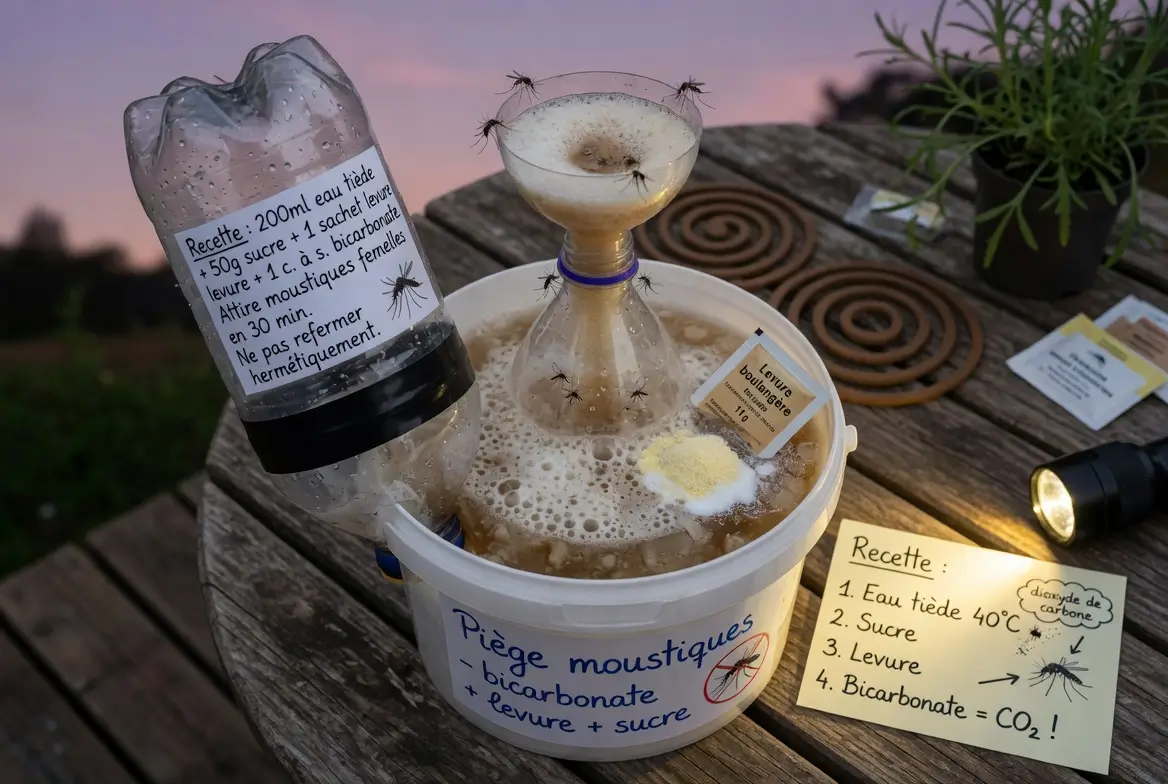
How to attract mosquitoes with a DIY trap: the bicarbonate, yeast and sugar recipe
The most popular DIY trap is based on fermentation. The principle is simple: produce CO₂ at home to reproduce the human respiratory signal. The classic recipe mixes sugar and baker's yeast in a cut and inverted plastic bottle, sometimes with a bicarbonate variant. Here's how it works and what its real limitations are.
The classic sugar + yeast recipe
Mix 200 g of sugar in 200 ml of warm water (40°C maximum, otherwise you will kill the yeast), then add 1 g of dry baker's yeast. Fermentation starts in 30 to 60 minutes and releases CO₂ for 1 to 2 weeks depending on the temperature. Place the mixture into the bottom of a 1.5 L plastic bottle cut 15 cm from the neck, then turn the neck downwards to form a funnel. Mosquitos attracted to CO₂ enter and remain trapped on the surface of the liquid.
The bicarbonate variant
This version replaces the yeast with 50 g of baking soda and 100 ml of white vinegar. The acid-base reaction produces CO₂ instantly, but it is exhausted in just 2 to 4 hours. It is an emergency solution, not a lasting protection.
The real limits of DIY
On paper, these traps seem to be effective. In practice, they disappoint quickly for four major reasons.
- Very low CO₂ production : a sugar-yeast trap releases 0.5 to 2 g of CO₂ per hour, i.e. 15 to 70 times less than a human at rest (35 g/h). The attraction range does not exceed 1 to 2 meters, compared to 30 meters for a human.
- No additional signals : CO₂ alone does not imitate a human. Without heat, humidity, octenol or lactic acid, the feather remains very unspecific and mainly captures flies and gnats.
- Limited duration of effectiveness : fermentation is exhausted in 7 to 14 days for yeast and in 2 to 4 hours for bicarbonate. Over a season of 5 months, the solution must be renewed 10 to 20 times.
- Confused capture : field studies show that these traps capture on average less than 5% of mosquitoes among the trapped insects, compared to 98% on a professional CO₂ trap.
These pitfalls remain interesting as a complement to a global strategy, but they are not enough to protect a garden. For an in-depth guide to CO₂ mosquito traps, see our detailed comparison of the available solutions.
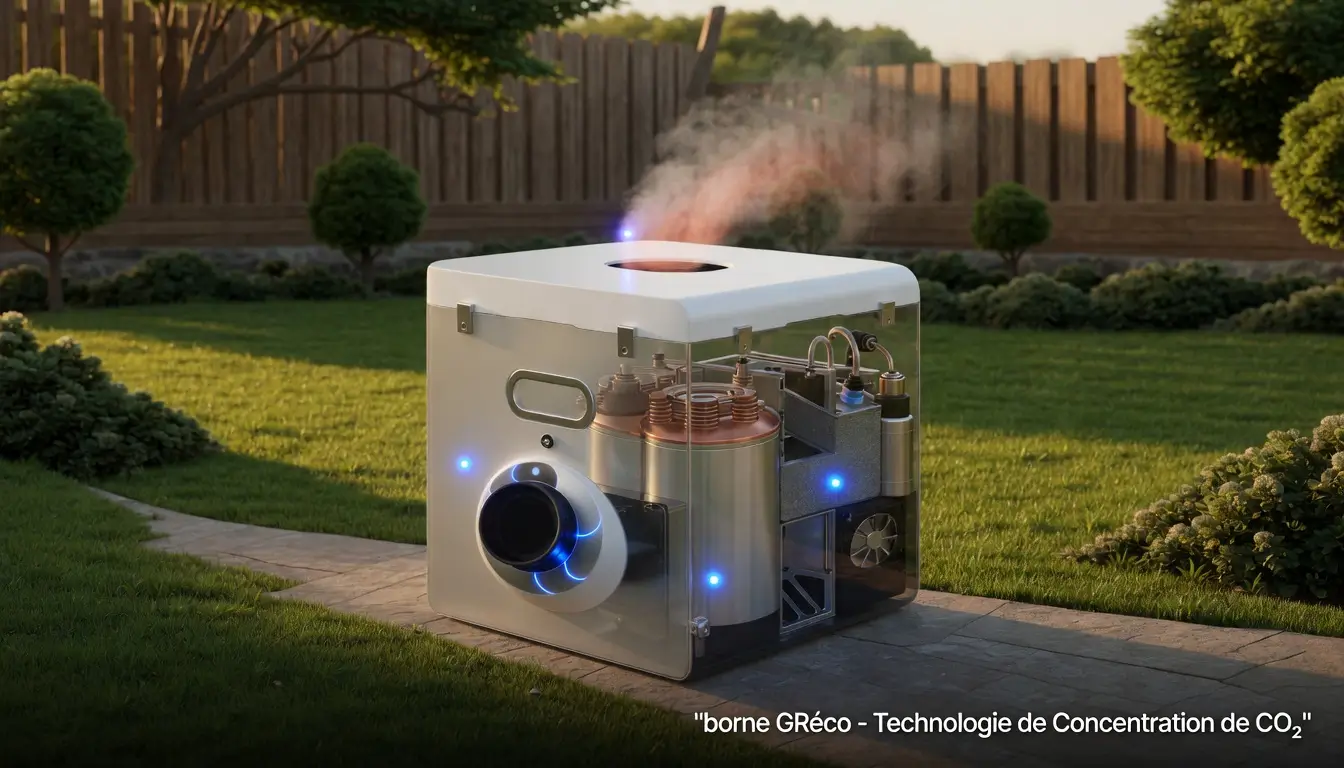
How to attract mosquitoes professionally: the CO₂ reactor
To attract mosquitoes effectively and continuously, the professional solution is based on a device capable of simultaneously reproducing the six human signals, in realistic quantities, without intervention. The Garden Reclaimer GréCo terminal is the most successful illustration of this in 2026.
The heart of the device is a patented atmospheric concentration reactor that captures CO₂ from the ambient air and concentrates it to generate an attractive plume equivalent to that of a human in light activity. No gas bottles to refill, no heavy consumables. The device continuously produces 30 to 50 g of CO₂ per hour, exactly within the range of a human at rest.
To this basic signal are added complementary decoys: infrared heat at 35-37°C, humidification of the feather, and diffusion of synthetic olfactory decoys (octenol and lactic acid). The result is an attractive plume that faithfully imitates the human signature and covers a radius of 30 to 60 meters around the terminal. To learn more about the technology, visit the page Operation of the GréCo terminal.
Once attracted, the females are sucked into a catch net where they die by desiccation within a few hours. The trap does not release chemicals or insecticides. Field surveys show that more than 80% of the mosquitoes caught by GréCO are breeding females, which maximizes the effect on the local population.
Comparing DIY lures vs CO₂ trap pro
How to attract mosquitoes: the key role of mass trapping females
Attracting mosquitoes only makes sense if you catch the right targets. Males don't sting or lay eggs, so capturing a male has no demographic impact. The female, on the other hand, lays between 100 and 300 eggs every 3 to 5 days during her 2 to 4 weeks of adult life. A single female left free generates 500 to 1,200 offspring over a season.
Mass trapping consists in intercepting these females before they sting and lay eggs. This principle has been documented since the 1990s by the vector control programs of ANSES and several European institutions. When a GréCo terminal captures 80 to 95% of the females present in its range of action, it mechanically reduces the next generation of mosquitoes on site.
The cumulative effect over 2 to 3 seasons is spectacular. A continuously protected garden sees its local population drop by 70 to 90% compared to year zero, because the trap prevents the population from being replenished every spring. This is exactly the opposite logic of insecticide sprays, which kill a few adults punctually without breaking the cycle. To go further, consult our comparison of effective mosquito traps.
Another dimension of massive trapping is its selectivity. The CO₂ + heat + olfactory lures plume specifically targets hematophagous diptera (mosquitoes, blackflies, ceratopogonids). Bees, butterflies, ladybugs, and lacewings are not attracted to this profile. According to the counts carried out on GréCo terminals in private gardens, more than 98% of the insects caught are mosquitoes. This precision makes it possible to protect the garden ecosystem while eliminating pests.
Where to place a trap to attract as many mosquitos as possible
Know How to attract mosquitos is not enough if the trap is placed incorrectly. Positioning determines 30 to 50% of the final yield. Here are the rules validated by field studies and user feedback.
Between the breeding area and the living area. Identify sources of mosquitoes (dense hedges, pond, ditch, humid neighborhood) and your terrace or play area. Place the trap halfway, ideally 10 to 15 meters away from the living area. This intercepts nocturnal migrating females before they reach humans.
Sheltered from the dominant wind. The attractive plume is dispersed by the wind. Exposure to more than 15 km/h reduces the range by 40 to 60%. Choose a location protected by a wall, hedge, or building, but without a frontal obstacle that would block the spread of the decoy.
At 60-80 cm from the ground. Mosquitos mostly fly at the height of human hips and shoulders. A trap placed on the ground attracts less, a trap that is too high also loses effectiveness. The ideal height corresponds to the level of a human sitting on a chair.
Far away from lighted areas. Artificial light sources (terrace lamps, projectors) attract a cocktail of non-target insects (moths, gnats) that saturate the net with no demographic value. Keep the trap at least 5 to 10 meters away from strong light sources.
Activated continuously, from the start of the season. The trap is not an emergency repellent. It takes 4 to 8 weeks of operation to observe a clear reduction in bites, because trapping acts on the reproductive cycle and not on the instant T. Put the terminal in service as early as March (south) or April (north) for maximum effect in summer.

How to attract mosquitoes without a trap: complementary lures
If you do not yet have a professional trap, some actions make it possible to concentrate mosquitoes on a secondary area to spare your terrace. This is the principle of the diversionary decoy, to be distinguished from massive trapping (which eliminates) and from repulsion (which repels).
Set up a waste water container (standing rain water, cold cooking water without salt) 10 meters from your living area. The females, attracted by the smell of organic water, come to lay their eggs there. Once eggs have been deposited, empty the container every 3 to 4 days to interrupt the larval cycle before emergence. It is a simple nesting trap, but it requires weekly vigilance to avoid creating a productive nest.
You can also diffuse pure octenol (sold in veterinary pharmacies or specialized garden centers) in a passive diffuser placed far from your terrace. The effectiveness is partial because octenol alone does not replicate the complete human cocktail, but it directs tiger mosquitoes to the decoy zone.
These solutions remain palliatives. None replicate the attraction of a professional CO₂ trap and none captures the females: they simply displace the nuisance. For real protection, active trapping remains essential. Discover our solutions on the page protection of individuals.
How to attract mosquitoes in 2026: what to remember
In 2026, understand How to attract mosquitos is equivalent to faithfully reproducing the human signature: CO₂ at 35 g/h, heat at 37°C, humidity, lactic acid, octenol and cutaneous pheromones. DIY traps (bicarbonate, sugar-yeast) reproduce only a fraction of these signals and remain limited to 1-2 meters in range for 7 to 14 days.
Professional trapping using an autonomous CO₂ reactor multiplies the range by 30 and captures 80 to 95% of breeding females, which breaks the demographic cycle over 2 to 3 seasons. The Garden Reclaimer GréCo terminal combines the six lures for an operating cost of €50 to €100 per season, without a gas bottle or chemical consumable. To assess your needs and obtain personalized investment advice, contact the Garden Reclaimer team.
This attraction-capture strategy is part of an ecological approach recognized by health authorities such asHANDLES. It effectively replaces chemical insecticides while respecting pollinators and useful garden auxiliaries. Well sized, it sustainably protects living areas without contaminating the environment.
FAQ: how to attract mosquitoes
What is the best lure to attract mosquitos?
The best decoy is the complete cocktail that mimics a human: CO₂ at 30-50 g/h, heat at 37°C, high humidity, lactic acid and octenol. None of these signals taken in isolation are sufficiently attractive. CO₂ alone increases to a few meters, but combined with the other decoys, it reaches a radius of 30 to 60 meters. This is what distinguishes a professional trap like the GréCo terminal from a DIY bicarbonate or yeast trap: the simultaneous reproduction of the six human signals, in realistic quantities and continuously throughout the season.
Is the bicarbonate, yeast and sugar trap really effective?
The sugar-yeast trap captures a few mosquitoes, but its effectiveness is very limited. It produces 0.5 to 2 g of CO₂ per hour, 15 to 70 times less than a human at rest, and its radius of attraction does not exceed 1 to 2 meters. Fermentation is exhausted in 7 to 14 days and requires constant renewal. Above all, the absence of heat, humidity and specific olfactory lures means that less than 5% of the insects caught are mosquitoes. It is a nice educational aid, not a protective solution. For real protection of a garden, you must turn to a professional CO₂ trap such as the GréCo terminal.
Why do mosquitoes bite some people more than others?
There are several factors that explain individual differences in attractiveness. CO₂ production varies according to weight, metabolism and physical activity: an athletic or pregnant person exhales up to 20% more CO₂. The composition of the cutaneous bacterial flora plays a major role: some bacteria produce very attractive compounds such as butyric acid or ammonia. Blood type O attracts statistically 1.8 times more than group A according to a study by the Japanese Institute of Parasitology. Finally, alcohol consumption increases skin temperature and CO₂ production, which increases attraction by about 15% in the hour following absorption.
How far away can a mosquito detect a human?
Female mosquitoes detect human CO₂ up to 30 meters away in calm conditions (without strong wind). At short distances (5 to 10 meters), they use volatile organic compounds released by the skin (lactic acid, octenol, ammonia). At 1-2 meters, infrared heat and humidity take over to guide the female precisely to the sting area. This multi-layered sensory strategy explains why an effective trap must reproduce all the signals: picking up a female from 30 meters away requires a powerful CO₂ plume, but guiding it to the final suction also requires heat, humidity and short-distance olfactory lures.
Does mass trapping really reduce the mosquito population?
Yes, as long as you act on the breeding females. A GréCo terminal captures 80 to 95% of the females present in its range of action, i.e. potentially 200 to 500 females per week at the peak of the season. As each female can lay 300 to 900 eggs during her adult life, their elimination prevents the birth of 60,000 to 450,000 mosquitoes per season in a protected area. The vector control programs of EID Mediterranean and ANSES have confirmed this mechanism since the 2000s. Over 2 to 3 consecutive seasons, the local population falls by 70 to 90%, provided that the neighbors do not maintain major breeding sites themselves.